疴 (kē) means "illness" in Chinese. It has 10 strokes with the radical 疒.
Rated 4.2/5 in difficulty (advanced).
Appears in 3+ common words including 沉疴 (chén kē), 宿疴 (sù kē), 疴疾 (kē jí).
Due to its 10 strokes, Hanzi Writer's error detection shows 疴 requires focused practice — most learners need 10+ attempts for consistent accuracy.
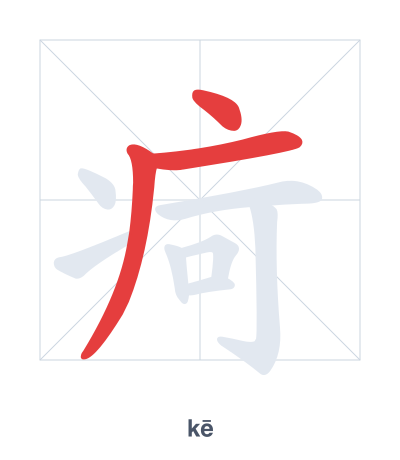
Open Hanzi Writer to see the animated stroke order and practice writing 疴 with real-time feedback.
The character 疴 (kē) is written with 10 strokes. Follow the standard Chinese stroke order: top to bottom, left to right, outside before inside. The radical 疒 is one of its key components.
Practice the correct stroke order with the Hanzi Writer app to see animated stroke-by-stroke guidance with real-time feedback.
疴 means illness.
疴 is a phono-semantic compound combining the radical 疒 (sickbed, illness) with 可 (kě, 'possible' or 'can') as a phonetic hint. The radical grounds the meaning in disease, while 可 approximates the sound kē, forming a character that originally referred to a severe or chronic illness.
💡 Memory Tip: Picture a patient on a sickbed (疒) weakly nodding 'okay' (可) when asked if they're still in pain, because this illness just won't go away.
他染上了沉疴。
tā rǎn shàng le chén kē
He fell ill with a chronic disease.
这种病是宿疴。
zhè zhǒng bìng shì sù kē
This disease is a chronic ailment.
医生治好了他的疴疾。
yī shēng zhì hǎo le tā de kē jí
The doctor cured his chronic illness.
Open Hanzi Writer to see the animated stroke order and practice writing 疴 with real-time feedback.
✨ Animated stroke order · Handwriting recognition · HSK-graded practice · Free to use
疴 is made of the radical 疒 (sickness) on the left, and the phonetic component 可 (kě) on the right. The radical directly gives the meaning of illness, while 可 provides the pronunciation clue. Together they form a character that means 'illness'.