糠 (kāng) means "Chaff / Bran / Husk" in Chinese. It has 17 strokes with the radical 米.
Rated 4.2/5 in difficulty (advanced).
Appears in 3+ common words including 谷糠 (gǔ kāng), 糟糠 (zāo kāng), 糠了 (kāng le).
Due to its 17 strokes, Hanzi Writer's error detection shows 糠 requires focused practice — most learners need 10+ attempts for consistent accuracy.
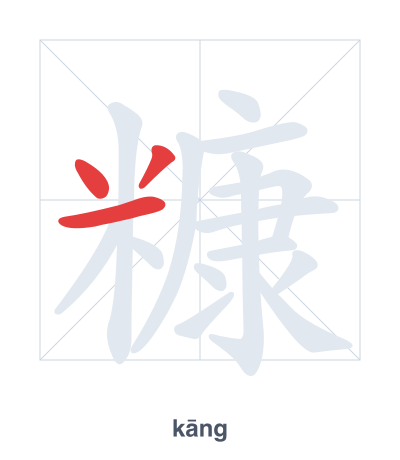
Open Hanzi Writer to see the animated stroke order and practice writing 糠 with real-time feedback.
The character 糠 (kāng) is written with 17 strokes. Follow the standard Chinese stroke order: top to bottom, left to right, outside before inside. The radical 米 is one of its key components.
Practice the correct stroke order with the Hanzi Writer app to see animated stroke-by-stroke guidance with real-time feedback.
糠 means Chaff / Bran / Husk.
糠 is a semantic-phonetic compound. The radical 米 (rice) indicates the meaning relates to grain, while 康 provides the pronunciation (kāng). Together they represent the outer husk of rice, known as chaff or bran.
💡 Memory Tip: Picture a rice grain (米) that is so healthy (康) that it shakes off its useless husk (糠) like a coat.
谷糠可以喂猪。
gǔ kāng kě yǐ wèi zhū
Grain bran can be used to feed pigs.
他不忘糟糠之妻。
tā bù wàng zāo kāng zhī qī
He doesn't forget the wife who shared his hardships.
萝卜已经糠了。
luó bo yǐ jīng kāng le
The radish has become spongy and lost its moisture.
Open Hanzi Writer to see the animated stroke order and practice writing 糠 with real-time feedback.
✨ Animated stroke order · Handwriting recognition · HSK-graded practice · Free to use
The character 糠 is composed of the radical 米 (rice) on the left, which shows that the meaning is related to rice or grain. The right part 康 (kāng) gives the sound and also hints at the idea of "healthy" or "peaceful", but here it mainly acts as a phonetic component. So 糠 literally means the outer husk or bran of rice, which is the part removed to get clean rice.