蒈 (kǎi) means "carene (chemical compound)" in Chinese. It has 12 strokes with the radical 艹.
Rated 4.2/5 in difficulty (advanced).
Appears in 3+ common words including 蒈烯 (kǎi xī), 蒈烷 (kǎi wán), 蒈酮 (kǎi tóng).
Due to its 12 strokes, Hanzi Writer's error detection shows 蒈 requires focused practice — most learners need 10+ attempts for consistent accuracy.
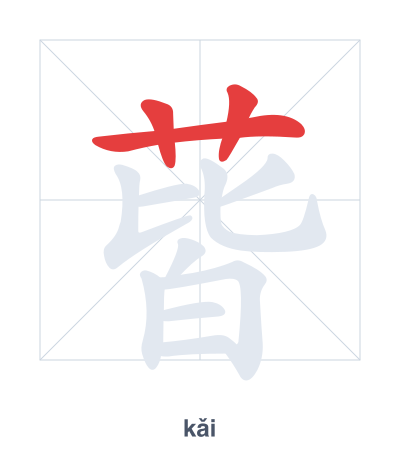
Open Hanzi Writer to see the animated stroke order and practice writing 蒈 with real-time feedback.
The character 蒈 (kǎi) is written with 12 strokes. Follow the standard Chinese stroke order: top to bottom, left to right, outside before inside. The radical 艹 is one of its key components.
Practice the correct stroke order with the Hanzi Writer app to see animated stroke-by-stroke guidance with real-time feedback.
蒈 means carene (chemical compound).
蒈 is a modern phono-semantic compound. The radical 艹 indicates it is an organic chemical compound, while the component 岂 provides a phonetic clue to its pronunciation kǎi.
💡 Memory Tip: Imagine grass (艹) asking 'kǎi?' (like 'carene?') with a confused face (岂), because it's a chemical found in plants.
蒈烯是一种物质。
kǎi xī shì yī zhǒng wù zhì
Carene is a substance.
蒈烷的化学式。
kǎi wán de huà xué shì
The chemical formula of carane.
蒈酮的性质。
kǎi tóng de xìng zhì
The properties of carone.
Open Hanzi Writer to see the animated stroke order and practice writing 蒈 with real-time feedback.
✨ Animated stroke order · Handwriting recognition · HSK-graded practice · Free to use
蒈 is a phono-semantic compound. The top part 艹 is the radical for "grass," but here it marks the character as an organic chemical. The bottom part 凯 (kǎi) gives the pronunciation and has no meaning related to carene.