舅 (jiù) means "maternal uncle" in Chinese. It has 13 strokes with the radical 臼, and is HSK Level 7.
Rated 4.2/5 in difficulty (advanced).
Harder than 85% of HSK Level 7 characters.
Appears in 3+ common words including 舅舅 (jiù jiù), 舅妈 (jiù mā), 大舅 (dà jiù).
Due to its 13 strokes, Hanzi Writer's error detection shows 舅 requires focused practice — most learners need 10+ attempts for consistent accuracy.
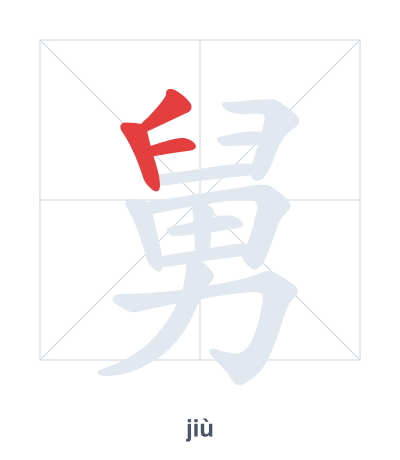
Open Hanzi Writer to see the animated stroke order and practice writing 舅 with real-time feedback.
The character 舅 (jiù) is written with 13 strokes. Follow the standard Chinese stroke order: top to bottom, left to right, outside before inside. The radical 臼 is one of its key components.
Practice the correct stroke order with the Hanzi Writer app to see animated stroke-by-stroke guidance with real-time feedback.
舅 means maternal uncle.
As an HSK Level 7 character, 舅 is an intermediate-level character.
舅 combines 臼 (mortar, also providing the sound jiù) and 男 (male) to signify a male relative from the mother's side—your maternal uncle.
💡 Memory Tip: Imagine your uncle pounding rice in a mortar (臼) while flexing his manly muscles (男) to remind you he is your mom's brother.
我舅舅在上海工作。
wǒ jiù jiù zài shàng hǎi gōng zuò
My uncle works in Shanghai.
舅妈做的菜很好吃。
jiù mā zuò de cài hěn hǎo chī
The dishes made by my aunt are delicious.
大舅是妈妈的哥哥。
dà jiù shì mā mā dī gē gē
The eldest maternal uncle is the mother's elder brother.
Open Hanzi Writer to see the animated stroke order and practice writing 舅 with real-time feedback.
✨ Animated stroke order · Handwriting recognition · HSK-graded practice · Free to use
The character 舅 is composed of the radical 臼 (mortar) on top and 男 (male) on the bottom. The top part 臼 gives a phonetic hint, while 男 directly indicates a male relative. Together they form the meaning of 'maternal uncle.'