臼 (jiù) means "Mortar." in Chinese. It has 6 strokes with the radical 臼.
Rated 2.9/5 in difficulty (moderate).
Appears in 3+ common words including 臼齿 (jiù chǐ), 石臼 (shí jiù), 脱臼 (tuō jiù).
Hanzi Writer's stroke validation shows learners typically need 5-8 attempts to write 臼 with correct proportion and order.
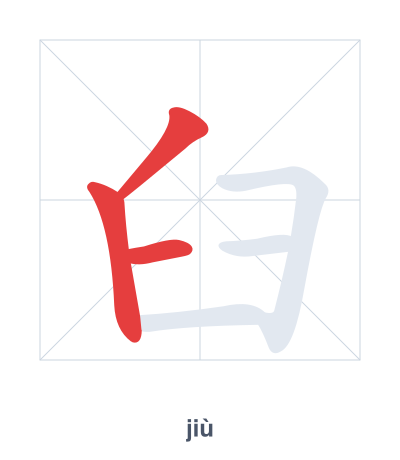
Open Hanzi Writer to see the animated stroke order and practice writing 臼 with real-time feedback.
The character 臼 (jiù) is written with 6 strokes. Follow the standard Chinese stroke order: top to bottom, left to right, outside before inside. The radical 臼 is one of its key components.
Practice the correct stroke order with the Hanzi Writer app to see animated stroke-by-stroke guidance with real-time feedback.
臼 means Mortar..
| Character | 臼 |
| Pinyin | jiù (jiu) |
| Meaning | Mortar. |
| Strokes | 6 |
| Radical | 臼 |
| Difficulty | 2.9/5 |
This character is a pictograph of a mortar—the ancient form depicts a stone or wooden bowl with a hollowed center, used for pounding grains. The top and bottom strokes represent the rim, while the inner space shows the cavity.
💡 Memory Tip: Imagine a square stone bowl with two deep grooves inside, like a mortar ready for a pestle to crush spices.
我的臼齿有点疼。
wǒ de jiù chǐ yǒu diǎn téng
My molar hurts a bit.
奶奶用石臼磨豆子。
nǎi nǎi yòng shí jiù mó dòu zi
Grandma uses a stone mortar to grind beans.
他的胳膊脱臼了。
tā de gē bó tuō jiù le
His arm is dislocated.
Open Hanzi Writer to see the animated stroke order and practice writing 臼 with real-time feedback.
✨ Animated stroke order · Handwriting recognition · HSK-graded practice · Free to use
臼 is a pictograph of a mortar, a bowl-shaped tool used for grinding. Its shape looks like a container with a hollow center. The character itself is the radical, so it does not break into smaller meaningful parts.