茎 (jīng) means "stem" in Chinese. It has 8 strokes with the radical 艹, and is HSK Level 7.
Rated 3.7/5 in difficulty (challenging).
Harder than 30% of HSK Level 7 characters.
Appears in 3+ common words including 茎部 (jīng bù), 根茎 (gēn jīng), 花茎 (huā jīng).
Due to its 8 strokes, Hanzi Writer's error detection shows 茎 requires focused practice — most learners need 10+ attempts for consistent accuracy.
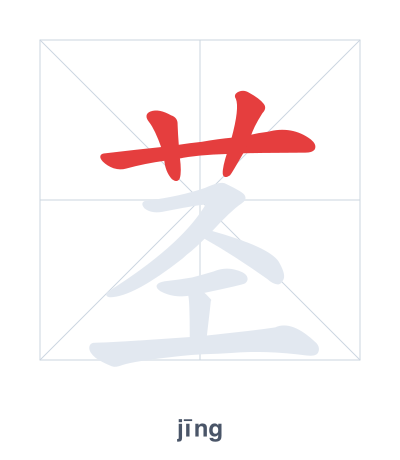
Open Hanzi Writer to see the animated stroke order and practice writing 茎 with real-time feedback.
The character 茎 (jīng) is written with 8 strokes. Follow the standard Chinese stroke order: top to bottom, left to right, outside before inside. The radical 艹 is one of its key components.
Practice the correct stroke order with the Hanzi Writer app to see animated stroke-by-stroke guidance with real-time feedback.
茎 means stem.
As an HSK Level 7 character, 茎 is an intermediate-level character.
茎 combines the grass radical 艹 (cǎo) with the phonetic component 巠 (jīng, meaning 'vertical thread' in weaving). The top signals a plant, while the bottom suggests a straight, upright line—together depicting the main stem that rises like a warp thread from the earth.
💡 Memory Tip: Imagine a blade of grass (艹) shooting up with a straight line (like the letter 'Y' from 巠) forming its central stem.
观察植物的茎部。
guān chá zhí wù de jīng bù
Observe the stem of the plant.
这个根茎很大。
zhè ge gēn jīng hěn dà
This rhizome is very large.
花茎变绿了。
huā jīng biàn lǜ le
The flower stem has turned green.
Open Hanzi Writer to see the animated stroke order and practice writing 茎 with real-time feedback.
✨ Animated stroke order · Handwriting recognition · HSK-graded practice · Free to use
茎 has the grass radical 艹 on top, which signals the character relates to plants. The bottom part 巠 provides the pronunciation jīng and suggests a shape like a stem or channel. Together, they create the meaning 'stem'.