觐 (jìn) means "To have an audience with (a monarch)" in Chinese. It has 15 strokes with the radical 见.
Rated 4.2/5 in difficulty (advanced).
Appears in 3+ common words including 觐见 (jìn jiàn), 朝觐 (cháo jìn), 觐礼 (jìn lǐ).
Due to its 15 strokes, Hanzi Writer's error detection shows 觐 requires focused practice — most learners need 10+ attempts for consistent accuracy.
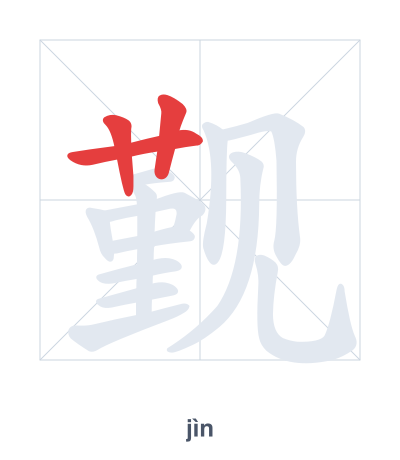
Open Hanzi Writer to see the animated stroke order and practice writing 觐 with real-time feedback.
The character 觐 (jìn) is written with 15 strokes. Follow the standard Chinese stroke order: top to bottom, left to right, outside before inside. The radical 见 is one of its key components.
Practice the correct stroke order with the Hanzi Writer app to see animated stroke-by-stroke guidance with real-time feedback.
觐 means To have an audience with (a monarch).
| Character | 觐 |
| Pinyin | jìn (jin) |
| Meaning | To have an audience with (a monarch) |
| Strokes | 15 |
| Radical | 见 |
| Difficulty | 4.2/5 |
觐 is a phono-semantic compound: the radical 见 (to see) indicates the meaning of going to see someone, while the phonetic component 堇 (jǐn) provides the sound. In ancient China, subjects would 'see' or have an audience with the emperor, so the character visually combines 'seeing' with a phonetic hint.
💡 Memory Tip: Picture a kneeling subject (the left part 堇, shaped like a person bowing) using their eye (见) to respectfully look up at the monarch during an audience.
使者去觐见国王。
shǐ zhě qù jìn jiàn guó wáng
The envoy went to have an audience with the king.
信徒们去圣地朝觐。
xìn tú men qù shèng dì cháo jìn
The believers went on a pilgrimage to the holy land.
他们正在举行觐礼。
tā men zhèng zài jǔ xíng jìn lǐ
They are performing an audience ceremony.
Open Hanzi Writer to see the animated stroke order and practice writing 觐 with real-time feedback.
✨ Animated stroke order · Handwriting recognition · HSK-graded practice · Free to use
The character 觐 is made of the radical 见 (jiàn, meaning 'to see') on the right side, and a phonetic component 堇 (jǐn) on the left. Since 见 relates to seeing or meeting, and the left part gives a hint of the pronunciation, together they suggest 'to go see a monarch' — an audience with a ruler.