Hanzi Writer

How to Write 堇 (jǐn) — Meaning “violet (flower); yellowish clay”

jǐn 11 strokes Radical: 土

堇 (jǐn) means "violet (flower); yellowish clay" in Chinese. It has 11 strokes with the radical 土.

Rated 4.2/5 in difficulty (advanced).

Appears in 3+ common words including 堇色 (jǐn sè), 堇菜 (jǐn cài), 堇年 (jǐn nián).

Due to its 11 strokes, Hanzi Writer's error detection shows 堇 requires focused practice — most learners need 10+ attempts for consistent accuracy.
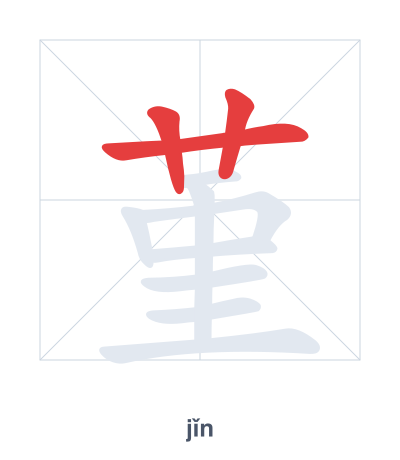
Stroke order practice for 堇 - jǐn

Practice Writing 堇 (jǐn)

Open Hanzi Writer to see the animated stroke order and practice writing 堇 with real-time feedback.

The character (jǐn) is written with 11 strokes. Follow the standard Chinese stroke order: top to bottom, left to right, outside before inside. The radical is one of its key components.

Practice the correct stroke order with the Hanzi Writer app to see animated stroke-by-stroke guidance with real-time feedback.

means violet (flower); yellowish clay.

Character
Pinyinjǐn (jin)
Meaningviolet (flower); yellowish clay
Strokes11
Radical
Difficulty4.2/5

This character combines the radical 土 (earth/clay) with a top component depicting a stylized violet flower (廿 representing leaves, 口 the bloom), suggesting a plant growing from yellowish clay soil. Historically, the upper part may derive from a pictograph of a person with a burning torch, but in modern usage the structure visually connects the flower shape to the earth radical.

💡 Memory Tip: Picture a violet flower with two broad leaves (廿) and a round blooming center (口) rooted firmly in clay (土).

jǐn sè
violet color
jǐn cài
violet (the plant)
jǐn nián
Jinnian (often a name)

她穿着堇色的衣服。

tā chuān zhe jǐn sè de yī fú

She is wearing violet-colored clothes.

花园里开了堇菜。

huā yuán lǐ kāi le jǐn cài

Violets are blooming in the garden.

这是一个美好的堇年。

zhè shì yí gè měi hǎo de jǐn nián

This is a beautiful youth.

Character Pinyin Strokes Radical
(current) jǐn 11
xíng 9
dòng 9
lěi 9
Stroke order practice for 堇 - jǐn

Practice Writing 堇 (jǐn)

Open Hanzi Writer to see the animated stroke order and practice writing 堇 with real-time feedback.

✨ Animated stroke order · Handwriting recognition · HSK-graded practice · Free to use

Frequently Asked Questions about 堇

堇 is made of three parts: 廿 (twenty) on top, 口 (mouth) in the middle, and 土 (earth) at the bottom. The bottom radical 土 relates to the meaning of yellowish clay, while the plant meaning "violet" comes from the whole character's ancient use. The top and middle parts do not directly show a flower, but together they create a unique shape.

Characters with Radical 土

Other 11-Stroke Characters