颃 (háng) means "To fly down" in Chinese. It has 10 strokes with the radical 页.
Rated 4.2/5 in difficulty (advanced).
Appears in 2+ common words including 颉颃 (xié háng), 颃颉 (háng jié).
Due to its 10 strokes, Hanzi Writer's error detection shows 颃 requires focused practice — most learners need 10+ attempts for consistent accuracy.
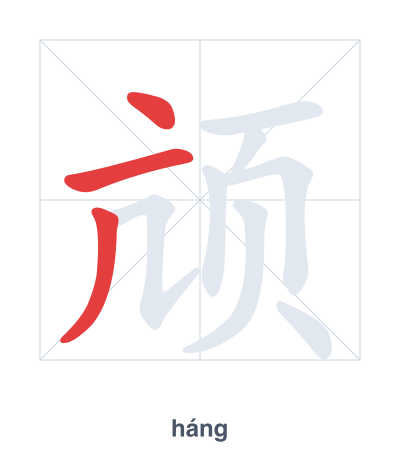
Open Hanzi Writer to see the animated stroke order and practice writing 颃 with real-time feedback.
The character 颃 (háng) is written with 10 strokes. Follow the standard Chinese stroke order: top to bottom, left to right, outside before inside. The radical 页 is one of its key components.
Practice the correct stroke order with the Hanzi Writer app to see animated stroke-by-stroke guidance with real-time feedback.
颃 means To fly down.
The character 颃 is a phono-semantic compound: the radical 页 (head) provides the semantic field, while 亢 (háng/kàng, meaning 'high' or 'neck') gives the sound. In ancient usage, 颃 originally referred to the neck or throat, but in the term 颉颃 (xié háng), it describes the motion of birds flying up (颉) and down (颃), linking the head's position to the flight path.
💡 Memory Tip: Picture a bird with a huge head (页) diving downward from a high perch (亢) — that's 颃, 'to fly down'.
两人的水平不相颉颃。
liǎng rén de shuǐ píng bù xiāng xié háng
Their levels are comparable and evenly matched.
鸟儿在空中颃颉。
niǎo ér zài kōng zhōng háng jié
The bird is flying up and down in the air.
这两支球队实力颉颃。
zhè liǎng zhī qiú duì shí lì xié háng
The strengths of these two teams are evenly matched.
Open Hanzi Writer to see the animated stroke order and practice writing 颃 with real-time feedback.
✨ Animated stroke order · Handwriting recognition · HSK-graded practice · Free to use
颃 is made of two parts: the left side 亢 (kàng) and the right side 页 (yè, meaning "head" or "page"). The radical 页 suggests the meaning relates to the head or neck, and the left part 亢 provides the sound. Together, the character originally referred to the neck, but in compounds like 颉颃 it describes the motion of flying up and down.