糨 (jiàng) means "Starch / Paste / Thick liquid" in Chinese. It has 18 strokes with the radical 米.
Rated 4.2/5 in difficulty (advanced).
Appears in 3+ common words including 糨糊 (jiàng hù), 糨子 (jiàng zi), 煮糨了 (zhǔ jiàng le).
Due to its 18 strokes, Hanzi Writer's error detection shows 糨 requires focused practice — most learners need 10+ attempts for consistent accuracy.
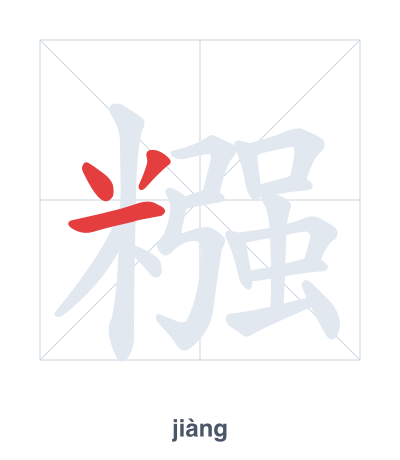
Open Hanzi Writer to see the animated stroke order and practice writing 糨 with real-time feedback.
The character 糨 (jiàng) is written with 18 strokes. Follow the standard Chinese stroke order: top to bottom, left to right, outside before inside. The radical 米 is one of its key components.
Practice the correct stroke order with the Hanzi Writer app to see animated stroke-by-stroke guidance with real-time feedback.
糨 means Starch / Paste / Thick liquid.
This character is a compound of 米 (rice) and 强 (qiáng, 'strong'). The rice radical indicates that the paste is made from grain, while 强 provides the sound and hints at the thick, strong consistency of the starch paste.
💡 Memory Tip: Imagine rice (米) being beaten into a thick paste by a strong (强) warrior wielding a bow (弓).
我用糨糊贴画。
wǒ yòng jiàng hù tiē huà
I use paste to stick pictures.
这里有一点糨子。
zhè lǐ yǒu yì diǎn jiàng zi
There is a bit of starch paste here.
这碗粥煮糨了。
zhè wǎn zhōu zhǔ jiàng le
This bowl of porridge has become thick and pasty.
Open Hanzi Writer to see the animated stroke order and practice writing 糨 with real-time feedback.
✨ Animated stroke order · Handwriting recognition · HSK-graded practice · Free to use
The character 糨 combines the radical 米 (rice) on the left with 强 (qiáng, meaning strong or stiff) on the right. Rice is the source of starch, so 米 hints at the substance, while 强 suggests the thick, sticky, or strong consistency of paste.