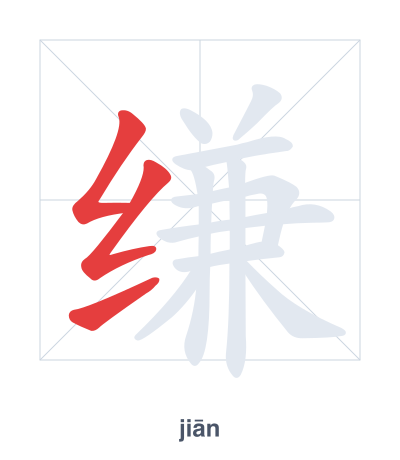
缣 (jiān) means "fine silk" in Chinese. It has 13 strokes with the radical 纟.
Rated 4.2/5 in difficulty (advanced).
Appears in 3+ common words including 缣帛 (jiān bó), 缣素 (jiān sù), 缣缃 (jiān xiāng).
Due to its 13 strokes, Hanzi Writer's error detection shows 缣 requires focused practice — most learners need 10+ attempts for consistent accuracy.
Open Hanzi Writer to see the animated stroke order and practice writing 缣 with real-time feedback.
The character 缣 (jiān) is written with 13 strokes. Follow the standard Chinese stroke order: top to bottom, left to right, outside before inside. The radical 纟 is one of its key components.
Practice the correct stroke order with the Hanzi Writer app to see animated stroke-by-stroke guidance with real-time feedback.
缣 means fine silk.
The character 缣 combines the silk radical 纟 with 兼 (double, combined). Ancient Chinese used this to denote a fine silk fabric woven with two strands of thread, making it both delicate and sturdy. The right component 兼 visually suggests 'holding two things together,' echoing the double-threaded weaving process.
💡 Memory Tip: Imagine a fine silk ribbon so splendid it's tied in a double bow (兼) with silky loops (纟).
古人在缣帛上写字。
gǔ rén zài jiān bó shàng xiě zì
Ancient people wrote on fine silk fabrics.
这是一卷缣素。
zhè shì yī juàn jiān sù
This is a roll of fine silk.
书架上有缣缃。
shū jià shàng yǒu jiān xiāng
There are silk-bound books on the bookshelf.
Open Hanzi Writer to see the animated stroke order and practice writing 缣 with real-time feedback.
✨ Animated stroke order · Handwriting recognition · HSK-graded practice · Free to use
缣 is composed of the radical 纟 (silk) on the left and the phonetic component 兼 (jiān, meaning 'double' or 'combine') on the right. The silk radical suggests the character relates to textiles, while 兼 hints at the idea of fine silk made from combined threads.