帛 (bó) means "Silk." in Chinese. It has 8 strokes with the radical 巾.
Rated 3.7/5 in difficulty (challenging).
Appears in 3+ common words including 帛画 (bó huà), 布帛 (bù bó), 财帛 (cái bó).
Due to its 8 strokes, Hanzi Writer's error detection shows 帛 requires focused practice — most learners need 10+ attempts for consistent accuracy.
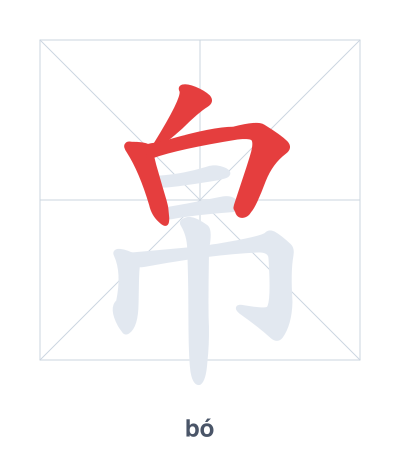
Open Hanzi Writer to see the animated stroke order and practice writing 帛 with real-time feedback.
The character 帛 (bó) is written with 8 strokes. Follow the standard Chinese stroke order: top to bottom, left to right, outside before inside. The radical 巾 is one of its key components.
Practice the correct stroke order with the Hanzi Writer app to see animated stroke-by-stroke guidance with real-time feedback.
帛 means Silk..
帛 combines 白 (white) and 巾 (cloth), literally meaning 'white cloth'—in ancient China, undyed silk was prized for its natural white color, so the character visually represents a piece of white fabric as silk.
💡 Memory Tip: Picture a pure white (白) cloth (巾) that feels so smooth and luxurious it must be silk.
博物馆里有帛画。
bó wù guǎn lǐ yǒu bó huà
There are silk paintings in the museum.
古人用布帛做衣服。
gǔ rén yòng bù bó zuò yī fú
Ancient people used cloth and silk to make clothing.
他不看重财帛。
tā bù kàn zhòng cái bó
He doesn't value wealth.
Open Hanzi Writer to see the animated stroke order and practice writing 帛 with real-time feedback.
✨ Animated stroke order · Handwriting recognition · HSK-graded practice · Free to use
帛 is composed of 白 (white) on top and 巾 (cloth) on the bottom. The white part suggests the natural color of raw silk, and 巾 indicates it is a type of fabric. Together they represent white silk cloth.