痂 (jiā) means "scab" in Chinese. It has 10 strokes with the radical 疒.
Rated 4.2/5 in difficulty (advanced).
Appears in 3+ common words including 结痂 (jié jiā), 痂皮 (jiā pí), 伤痂 (shāng jiā).
Due to its 10 strokes, Hanzi Writer's error detection shows 痂 requires focused practice — most learners need 10+ attempts for consistent accuracy.
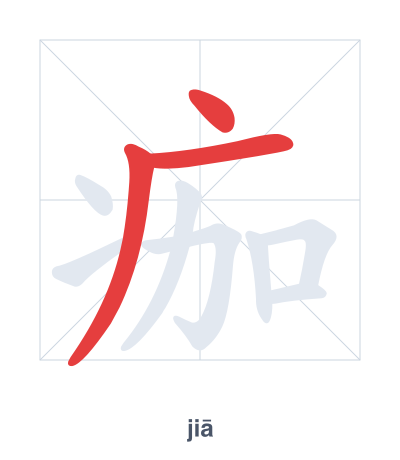
Open Hanzi Writer to see the animated stroke order and practice writing 痂 with real-time feedback.
The character 痂 (jiā) is written with 10 strokes. Follow the standard Chinese stroke order: top to bottom, left to right, outside before inside. The radical 疒 is one of its key components.
Practice the correct stroke order with the Hanzi Writer app to see animated stroke-by-stroke guidance with real-time feedback.
痂 means scab.
This compound character combines the illness radical 疒, indicating a wound or disease, with 加 (jiā, 'to add'), suggesting that a scab is something added over a healing injury. The structure thus visually depicts a scab as an addition atop a wound caused by illness or damage.
💡 Memory Tip: Picture a wound (疒) that gets a protective layer added (加) on top — that's the scab (痂).
伤口已经结痂了。
shāng kǒu yǐ jīng jié jiā le
The wound has already scabbed over.
痂皮快要脱落了。
jiā pí kuài yào tuō là le
The scab is about to fall off.
别去抠那个伤痂。
bié qù kōu nà ge shāng jiā
Don't pick at that scab.
Open Hanzi Writer to see the animated stroke order and practice writing 痂 with real-time feedback.
✨ Animated stroke order · Handwriting recognition · HSK-graded practice · Free to use
痂 combines the radical 疒 (sickness) on the left and the phonetic component 加 (jiā, meaning 'to add') on the right. The radical hints that the character relates to illness or skin conditions, while the sound comes from 加. Together, they create the meaning 'scab,' a small crust that forms over a healing wound.