赍 (jī) means "to present; to carry; to bestow" in Chinese. It has 12 strokes with the radical 贝.
Rated 4.2/5 in difficulty (advanced).
Appears in 3+ common words including 赍发 (jī fā), 赍赏 (jī shǎng), 赍恨 (jī hèn).
Due to its 12 strokes, Hanzi Writer's error detection shows 赍 requires focused practice — most learners need 10+ attempts for consistent accuracy.
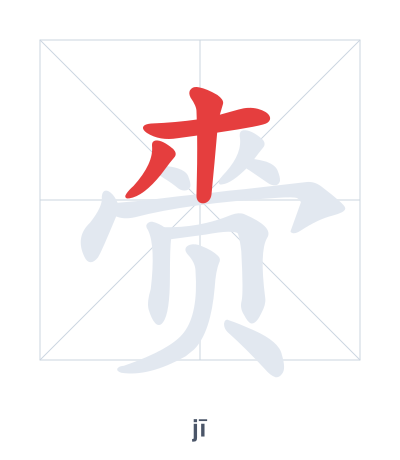
Open Hanzi Writer to see the animated stroke order and practice writing 赍 with real-time feedback.
The character 赍 (jī) is written with 12 strokes. Follow the standard Chinese stroke order: top to bottom, left to right, outside before inside. The radical 贝 is one of its key components.
Practice the correct stroke order with the Hanzi Writer app to see animated stroke-by-stroke guidance with real-time feedback.
赍 means to present; to carry; to bestow.
This character combines the phonetic component 齐 (qí, 'neat/equal') with the radical 贝 (shell, representing wealth). Together they suggest presenting gifts or carrying valuables in an orderly, proper manner.
💡 Memory Tip: Picture a neat stack (齐) of cowrie shells (贝) being carried and presented as a gift.
官府赍发了路费。
guān fǔ jī fā le lù fèi
The government office provided travel expenses.
国王赍赏了勇士。
guó wáng jī shǎng le yǒng shì
The king rewarded the brave warriors.
他赍恨而死。
tā jī hèn ér sǐ
He died with deep resentment.
Open Hanzi Writer to see the animated stroke order and practice writing 赍 with real-time feedback.
✨ Animated stroke order · Handwriting recognition · HSK-graded practice · Free to use
赍 is composed of 齐 (qi, meaning "equal" or "to arrange") on top and 贝 (shell, a symbol of wealth) below. Together, the parts suggest the idea of arranging or presenting valuable items, which connects to its meanings of "to present" and "to bestow."