畿 (jī) means "Imperial domain / Areas near the capital" in Chinese. It has 15 strokes with the radical 田.
Rated 4.2/5 in difficulty (advanced).
Appears in 3+ common words including 京畿 (jīng jī), 畿辅 (jī fǔ), 畿内 (jī nèi).
Due to its 15 strokes, Hanzi Writer's error detection shows 畿 requires focused practice — most learners need 10+ attempts for consistent accuracy.
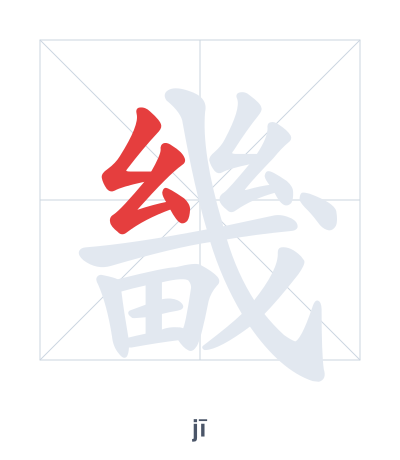
Open Hanzi Writer to see the animated stroke order and practice writing 畿 with real-time feedback.
The character 畿 (jī) is written with 15 strokes. Follow the standard Chinese stroke order: top to bottom, left to right, outside before inside. The radical 田 is one of its key components.
Practice the correct stroke order with the Hanzi Writer app to see animated stroke-by-stroke guidance with real-time feedback.
畿 means Imperial domain / Areas near the capital.
The character 畿 combines 田 (field) with 幾 (near/tiny), originally depicting the fields close to the capital—the imperial domain. The left side represents land, while the right side suggests proximity, together meaning 'areas near the royal seat.'
💡 Memory Tip: Picture a field (田) next to the capital, marked by a tiny flag (the 幾 shape) to show it's the emperor's special domain.
他住在京畿地区。
tā zhù zài jīng jī dì qū
He lives in the Gyeonggi region.
这里是畿辅重地。
zhè lǐ shì jī fǔ zhòng dì
This is a strategic area near the capital.
畿内交通很方便。
jī nèi jiāo tōng hěn fāng biàn
Transportation within the imperial domain is very convenient.
Open Hanzi Writer to see the animated stroke order and practice writing 畿 with real-time feedback.
✨ Animated stroke order · Handwriting recognition · HSK-graded practice · Free to use
畿 combines the radical 田 (field) with the phonetic component 幾 (jī). The 田 indicates land or territory, while 幾 suggests the pronunciation and the idea of 'near' or 'almost,' together pointing to land areas close to the capital that formed the imperial domain.