畹 (wǎn) means "Wan (ancient unit of land area)" in Chinese. It has 13 strokes with the radical 田.
Rated 4.2/5 in difficulty (advanced).
Appears in 3+ common words including 九畹 (jiǔ wǎn), 畹町 (wǎn tīng), 兰畹 (lán wǎn).
Due to its 13 strokes, Hanzi Writer's error detection shows 畹 requires focused practice — most learners need 10+ attempts for consistent accuracy.
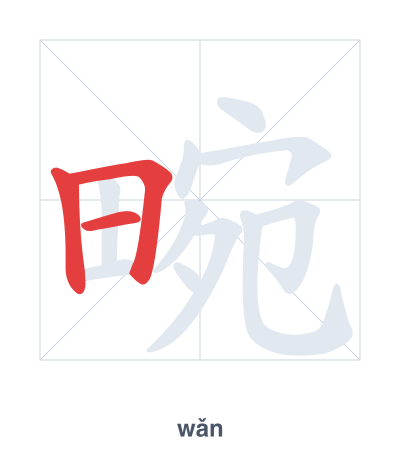
Open Hanzi Writer to see the animated stroke order and practice writing 畹 with real-time feedback.
The character 畹 (wǎn) is written with 13 strokes. Follow the standard Chinese stroke order: top to bottom, left to right, outside before inside. The radical 田 is one of its key components.
Practice the correct stroke order with the Hanzi Writer app to see animated stroke-by-stroke guidance with real-time feedback.
畹 means Wan (ancient unit of land area).
畹 is a phono-semantic compound. The radical 田 (field) indicates its connection to land measurement, while 宛 (wǎn) contributes the sound. This character denoted an ancient unit of area, often defined as 30 mu (about 5 acres).
💡 Memory Tip: Imagine a field (田) shaped like a winding snake (宛), marking exactly 30 mu of land.
园子里有九畹兰花。
yuán zi lǐ yǒu jiǔ wǎn lán huā
There are many orchids in the garden.
畹町是一个小镇。
wǎn tīng shì yí gè xiǎo zhèn
Wanding is a small town.
兰畹里花香扑鼻。
lán wǎn lǐ huā xiāng pū bí
The orchid garden is filled with a refreshing fragrance.
Open Hanzi Writer to see the animated stroke order and practice writing 畹 with real-time feedback.
✨ Animated stroke order · Handwriting recognition · HSK-graded practice · Free to use
The character 畹 is made of two parts: the left side is 田 (field), which shows the character is related to land or farming. The right side is 宛 (wǎn), which gives the pronunciation. Together, 畹 means an ancient unit of land area, so the 'field' radical is directly connected to the meaning.