畺 (jiāng) means "Boundary / Border" in Chinese. It has 13 strokes with the radical 田.
Rated 4.2/5 in difficulty (advanced).
Appears in 3+ common words including 畺界 (jiāng jiè), 畺理 (jiāng lǐ), 畺土 (jiāng tǔ).
Due to its 13 strokes, Hanzi Writer's error detection shows 畺 requires focused practice — most learners need 10+ attempts for consistent accuracy.
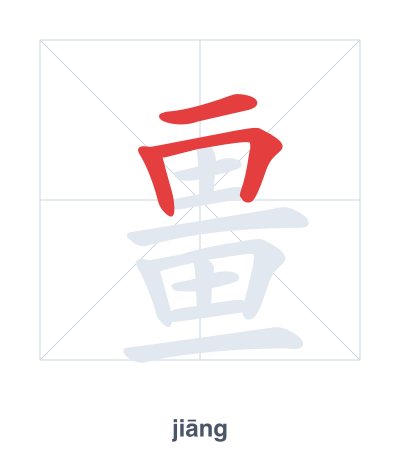
Open Hanzi Writer to see the animated stroke order and practice writing 畺 with real-time feedback.
The character 畺 (jiāng) is written with 13 strokes. Follow the standard Chinese stroke order: top to bottom, left to right, outside before inside. The radical 田 is one of its key components.
Practice the correct stroke order with the Hanzi Writer app to see animated stroke-by-stroke guidance with real-time feedback.
畺 means Boundary / Border.
畺 originally depicted two or three fields (田) arranged vertically, with lines between them representing the boundaries that separate one field from another. The character visually emphasizes the division between agricultural plots, thus conveying the idea of a border or frontier.
💡 Memory Tip: Imagine three stacked fields (田) separated by strict border lines, forming the shape 畺—a constant reminder that no farmer may cross these boundaries.
两国畺界很清晰。
liǎng guó jiāng jiè hěn qīng xī
The border between the two countries is very clear.
畺理土地很重要。
jiāng lǐ tǔ dì hěn zhòng yào
Managing the land is very important.
守护这片畺土。
shǒu hù zhè piàn jiāng tǔ
Guard this territory.
Open Hanzi Writer to see the animated stroke order and practice writing 畺 with real-time feedback.
✨ Animated stroke order · Handwriting recognition · HSK-graded practice · Free to use
畺 consists of three 田 (field) radicals stacked vertically. The top and bottom 田 represent boundary markers, while the middle 田 is the land being bordered. This vertical stacking visually suggests layers of fields with borders between them.