嵇 (jī) means "Ji (surname / mountain name)" in Chinese. It has 12 strokes with the radical 山.
Rated 4.2/5 in difficulty (advanced).
Appears in 3+ common words including 嵇康 (jī kāng), 姓嵇 (xìng jī), 嵇山 (jī shān).
Due to its 12 strokes, Hanzi Writer's error detection shows 嵇 requires focused practice — most learners need 10+ attempts for consistent accuracy.
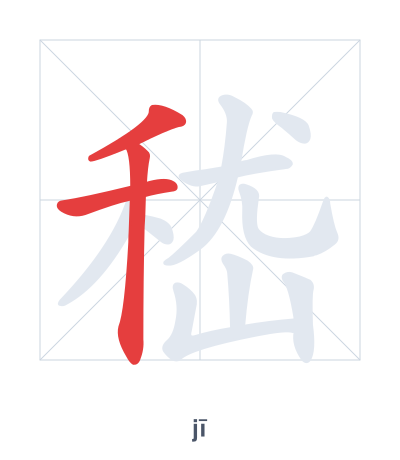
Open Hanzi Writer to see the animated stroke order and practice writing 嵇 with real-time feedback.
The character 嵇 (jī) is written with 12 strokes. Follow the standard Chinese stroke order: top to bottom, left to right, outside before inside. The radical 山 is one of its key components.
Practice the correct stroke order with the Hanzi Writer app to see animated stroke-by-stroke guidance with real-time feedback.
嵇 means Ji (surname / mountain name).
嵇 combines the mountain radical (山) with a phonetic component made of grain (禾) and a variant of 尤 (especially). It originally named a mountain in present-day Henan, later adopted as a prominent surname. The mountain radical visually anchors the character to its geographical origin.
💡 Memory Tip: Picture a mountain (山) with a stalk of grain (禾) growing on it, and a special dog (尤) guarding the slope — that's the surname Ji.
嵇康是古代的名人。
jī kāng shì gǔ dài de míng rén
Ji Kang is a famous person from ancient times.
他的老师姓嵇。
tā de lǎo shī xìng jī
His teacher's surname is Ji.
嵇山在什么地方?
jī shān zài shén me dì fāng
Where is Mount Ji?
Open Hanzi Writer to see the animated stroke order and practice writing 嵇 with real-time feedback.
✨ Animated stroke order · Handwriting recognition · HSK-graded practice · Free to use
The character 嵇 is a left-right structure. The left part 禾 means "grain," and the right part 山 means "mountain"; together they form a surname and the name of a mountain, Mount Ji. The combination suggests a mountain associated with crops, though the exact etymology is unclear and the meaning is primarily onomastic.