遑 (huáng) means "Leisure / Time" in Chinese. It has 12 strokes with the radical 辶.
Rated 4.2/5 in difficulty (advanced).
Appears in 3+ common words including 遑论 (huáng lùn), 不遑 (bù huáng), 遑遑 (huáng huáng).
Due to its 12 strokes, Hanzi Writer's error detection shows 遑 requires focused practice — most learners need 10+ attempts for consistent accuracy.
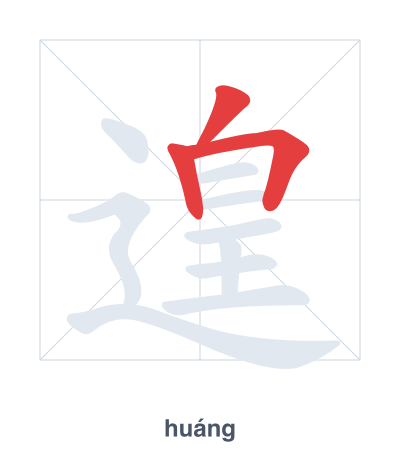
Open Hanzi Writer to see the animated stroke order and practice writing 遑 with real-time feedback.
The character 遑 (huáng) is written with 12 strokes. Follow the standard Chinese stroke order: top to bottom, left to right, outside before inside. The radical 辶 is one of its key components.
Practice the correct stroke order with the Hanzi Writer app to see animated stroke-by-stroke guidance with real-time feedback.
遑 means Leisure / Time.
遑 is a phono-semantic compound where the radical 辶 (walking/action) suggests movement, and the phonetic component 皇 (huáng, meaning 'emperor' or 'royal') provides the sound. Together, they evoke the idea of an emperor moving at a leisurely pace, having abundant time, which connects to the character's meaning of 'leisure' or 'free time.'
💡 Memory Tip: Picture an emperor (皇) taking a slow, relaxed walk (辶) because he has all the leisure time in the world.
遑论以后,先看现在。
huáng lùn yǐ hòu xiān kàn xiàn zài
Let alone the future, look at the present first.
他忙得不遑休息。
tā máng dé bù huáng xiū xī
He is so busy that he has no time to rest.
他整天遑遑不安。
tā zhěng tiān huáng huáng bù ān
He is flustered and anxious all day long.
Open Hanzi Writer to see the animated stroke order and practice writing 遑 with real-time feedback.
✨ Animated stroke order · Handwriting recognition · HSK-graded practice · Free to use
遑 consists of the radical 辶 (walking) on the left and 皇 (huáng, emperor) on the right. The 皇 gives the character its pronunciation, while 辶 suggests movement, linking to the idea of wandering freely — hence the meanings "leisure" or "free time."