磺 (huáng) means "sulfur (chemical prefix)" in Chinese. It has 16 strokes with the radical 石.
Rated 4.2/5 in difficulty (advanced).
Appears in 3+ common words including 硫磺 (liú huáng), 磺胺 (huáng àn), 磺酒 (huáng jiǔ).
Due to its 16 strokes, Hanzi Writer's error detection shows 磺 requires focused practice — most learners need 10+ attempts for consistent accuracy.
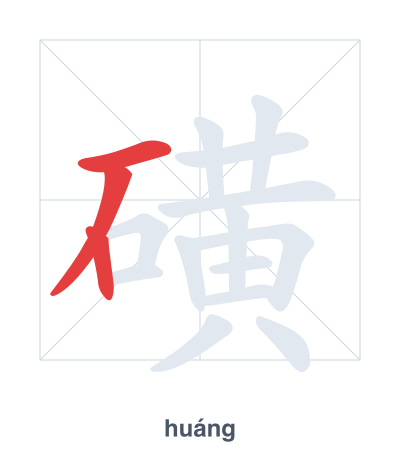
Open Hanzi Writer to see the animated stroke order and practice writing 磺 with real-time feedback.
The character 磺 (huáng) is written with 16 strokes. Follow the standard Chinese stroke order: top to bottom, left to right, outside before inside. The radical 石 is one of its key components.
Practice the correct stroke order with the Hanzi Writer app to see animated stroke-by-stroke guidance with real-time feedback.
磺 means sulfur (chemical prefix).
磺 combines the radical 石 (stone, indicating a mineral) with 黄 (yellow, providing phonetic hint and also suggesting its color). Together, it denotes sulfur, a yellow mineral often found in crystalline form.
💡 Memory Tip: Imagine a bright yellow stone (石) that smells like rotten eggs—that's sulfur.
硫磺可以用来做药。
liú huáng kě yǐ yòng lái zuò yào
Sulfur can be used to make medicine.
他吃了两片磺胺药。
tā chī le liǎng piàn huáng àn yào
He took two sulfa tablets.
他在伤口上涂了磺酒。
tā zài shāng kǒu shàng tú le huáng jiǔ
He applied iodine to the wound.
Open Hanzi Writer to see the animated stroke order and practice writing 磺 with real-time feedback.
✨ Animated stroke order · Handwriting recognition · HSK-graded practice · Free to use
磺 is made of the radical 石 (stone) on the left and the phonetic component 黄 (huáng, yellow) on the right. The radical 石 indicates that the character relates to minerals or stones, and sulfur is a yellow mineral. The right part 黄 gives the pronunciation huáng and hints at the yellow color of sulfur.