硫 (liú) means "sulfur" in Chinese. It has 12 strokes with the radical 石.
Rated 4.2/5 in difficulty (advanced).
Appears in 3+ common words including 硫磺 (liú huáng), 硫酸 (liú suān), 硫化物 (liú huà wù).
Due to its 12 strokes, Hanzi Writer's error detection shows 硫 requires focused practice — most learners need 10+ attempts for consistent accuracy.
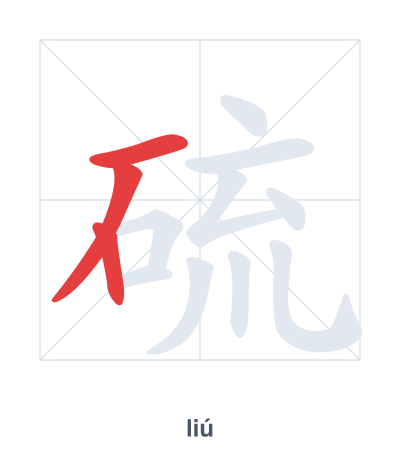
Open Hanzi Writer to see the animated stroke order and practice writing 硫 with real-time feedback.
The character 硫 (liú) is written with 12 strokes. Follow the standard Chinese stroke order: top to bottom, left to right, outside before inside. The radical 石 is one of its key components.
Practice the correct stroke order with the Hanzi Writer app to see animated stroke-by-stroke guidance with real-time feedback.
硫 means sulfur.
硫 is a semantic-phonetic compound. The left radical 石 (stone) indicates it is a mineral, and the right component 㐬 (liú) provides the pronunciation, originally depicting a flowing banner or child with flowing hair, here hinting at sulfur's tendency to flow when melted.
💡 Memory Tip: Picture a yellow sulfur rock (石) with a gooey, flowing stream (㐬) oozing out like lava.
温泉里有硫磺味。
wēn quán lǐ yǒu liú huáng wèi
There is a smell of sulfur in the hot spring.
硫酸有强腐蚀性。
liú suān yǒu qiáng fǔ shí xìng
Sulfuric acid is highly corrosive.
这种气体是硫化物。
zhè zhǒng qì tǐ shì liú huà wù
This gas is a sulfide.
Open Hanzi Writer to see the animated stroke order and practice writing 硫 with real-time feedback.
✨ Animated stroke order · Handwriting recognition · HSK-graded practice · Free to use
硫 is composed of the radical 石 (stone/rock) on the left and 㐬 (liú, a phonetic component) on the right. The radical 石 indicates that sulfur is a mineral found in rock, while the right side hints at its pronunciation liú.