鹮 (huán) means "ibis" in Chinese. It has 18 strokes with the radical 鸟.
Rated 4.2/5 in difficulty (advanced).
Appears in 3+ common words including 朱鹮 (zhū huán), 鹮类 (huán lèi), 保护鹮 (bǎo hù huán).
Due to its 18 strokes, Hanzi Writer's error detection shows 鹮 requires focused practice — most learners need 10+ attempts for consistent accuracy.
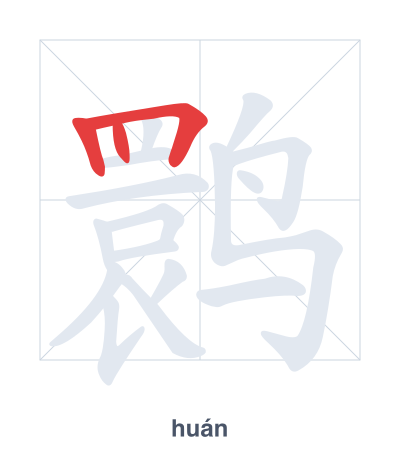
Open Hanzi Writer to see the animated stroke order and practice writing 鹮 with real-time feedback.
The character 鹮 (huán) is written with 18 strokes. Follow the standard Chinese stroke order: top to bottom, left to right, outside before inside. The radical 鸟 is one of its key components.
Practice the correct stroke order with the Hanzi Writer app to see animated stroke-by-stroke guidance with real-time feedback.
鹮 means ibis.
鹮 is a phono-semantic compound: 鸟 (bird) indicates its avian nature, and 睘 (huán, originally a circular jade ring) provides the pronunciation, possibly alluding to the ibis's curved beak or round eye.
💡 Memory Tip: Imagine an ibis with its long curved beak forming a perfect ring (睘) as it stands proudly on a branch shaped like the bird radical (鸟).
朱鹮是非常珍贵的鸟类。
zhū huán shì fēi cháng zhēn guì de niǎo lèi
The crested ibis is a very precious bird species.
这种鹮类生活在水边。
zhè zhǒng huán lèi shēng huó zài shuǐ biān
This kind of ibis lives by the water.
我们要保护这些鹮。
wǒ men yào bǎo hù zhè xiē huán
We must protect these ibises.
Open Hanzi Writer to see the animated stroke order and practice writing 鹮 with real-time feedback.
✨ Animated stroke order · Handwriting recognition · HSK-graded practice · Free to use
The character 鹮 is composed of the phonetic component 睘 (huán) on the left and the radical 鸟 (niǎo, meaning bird) on the right. The radical 鸟 tells you this character refers to a type of bird, while the left part gives a clue to its pronunciation.