郝 (hǎo) means "Hao (a surname)" in Chinese. It has 9 strokes with the radical 阝.
Rated 3.7/5 in difficulty (challenging).
Appears in 3+ common words including 郝医生 (hǎo yī shēng), 郝同学 (hǎo tóng xué), 姓郝 (xìng hǎo).
Due to its 9 strokes, Hanzi Writer's error detection shows 郝 requires focused practice — most learners need 10+ attempts for consistent accuracy.
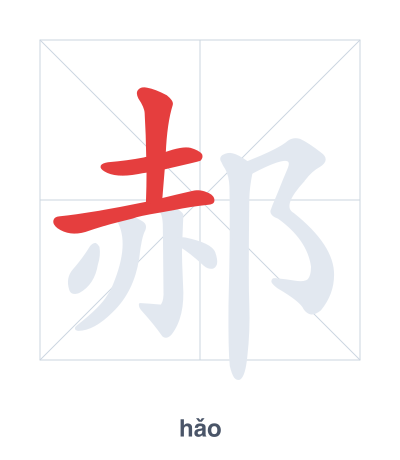
Open Hanzi Writer to see the animated stroke order and practice writing 郝 with real-time feedback.
The character 郝 (hǎo) is written with 9 strokes. Follow the standard Chinese stroke order: top to bottom, left to right, outside before inside. The radical 阝 is one of its key components.
Practice the correct stroke order with the Hanzi Writer app to see animated stroke-by-stroke guidance with real-time feedback.
郝 means Hao (a surname).
郝 is a compound character combining 赤 (red) and 阝 (a mound or hill). It originally referred to a place name, likely a hill associated with the Red clan, and later became a common Chinese surname.
💡 Memory Tip: Picture a red (赤) hill (阝) where the Hao family built their home.
郝医生在医院工作。
hǎo yī shēng zài yī yuàn gōng zuò
Dr. Hao works in a hospital.
郝同学学习很努力。
hǎo tóng xué xué xí hěn nǔ lì
Student Hao studies very hard.
我认识一个姓郝的人。
wǒ rèn shí yí gè xìng hǎo de rén
I know someone named Hao.
Open Hanzi Writer to see the animated stroke order and practice writing 郝 with real-time feedback.
✨ Animated stroke order · Handwriting recognition · HSK-graded practice · Free to use
郝 is composed of two parts: the left side 赤 (meaning 'red') and the right side 阝 (a variant of 邑, meaning 'town' or 'place'). Together, they originally referred to a place name in ancient China, and today 郝 is primarily used as a surname with no direct connection to 'red' or 'town'.