绗 (háng) means "To quilt or stitch." in Chinese. It has 9 strokes with the radical 纟.
Rated 4/5 in difficulty (challenging).
Appears in 3+ common words including 绗缝 (háng fèng), 绗棉 (háng mián), 绗线 (háng xiàn).
Due to its 9 strokes, Hanzi Writer's error detection shows 绗 requires focused practice — most learners need 10+ attempts for consistent accuracy.
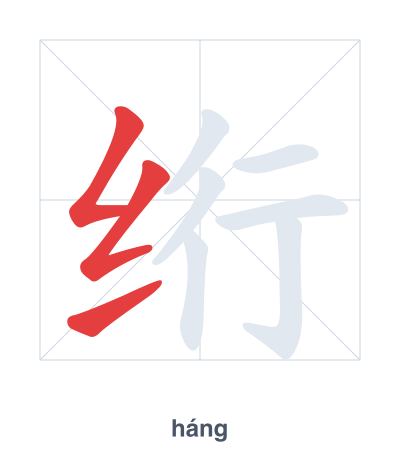
Open Hanzi Writer to see the animated stroke order and practice writing 绗 with real-time feedback.
The character 绗 (háng) is written with 9 strokes. Follow the standard Chinese stroke order: top to bottom, left to right, outside before inside. The radical 纟 is one of its key components.
Practice the correct stroke order with the Hanzi Writer app to see animated stroke-by-stroke guidance with real-time feedback.
绗 means To quilt or stitch..
绗 is a compound character combining the silk radical 纟 (thread) with 行 (háng, meaning row or line). The 行 component suggests stitching in straight rows, as in quilting, while 纟 indicates the thread used. Together, they depict the action of sewing long, parallel stitches through layers of fabric.
💡 Memory Tip: Picture a seamstress walking (行) a needle with silk thread (纟) in neat rows to quilt a blanket, each stitch forming a straight line.
奶奶在绗缝被子。
nǎi nǎi zài háng féng bèi zi
Grandma is quilting a blanket.
这件绗棉衣很暖和。
zhè jiàn háng mián yī hěn nuǎn huo
This quilted jacket is very warm.
绗线要整齐。
háng xiàn yào zhěng qí
The quilting stitches should be neat.
Open Hanzi Writer to see the animated stroke order and practice writing 绗 with real-time feedback.
✨ Animated stroke order · Handwriting recognition · HSK-graded practice · Free to use
绗 is made of two parts: the left radical 纟 (silk thread) and the right component 行 (meaning 'row' or 'line'). This combination suggests stitching along a line, which is exactly the action of quilting. The radical 纟 indicates that the character relates to thread or textile work.