Hanzi Writer

How to Write 翰 (hàn) — Meaning “writing brush; pen; writing”

hàn 16 strokes Radical: 羽

翰 (hàn) means "writing brush; pen; writing" in Chinese. It has 16 strokes with the radical 羽.

Rated 4.2/5 in difficulty (advanced).

Appears in 3+ common words including 约翰 (yuē hàn), 翰林 (hàn lín), 墨翰 (mò hàn).

Due to its 16 strokes, Hanzi Writer's error detection shows 翰 requires focused practice — most learners need 10+ attempts for consistent accuracy.
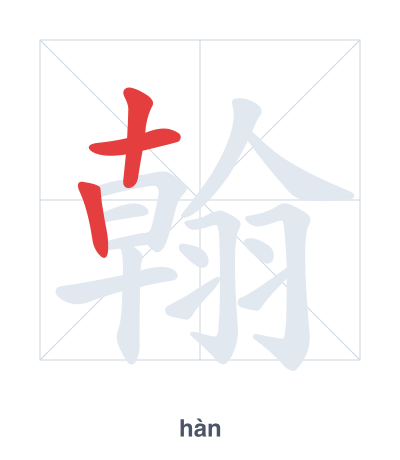
Stroke order practice for 翰 - hàn

Practice Writing 翰 (hàn)

Open Hanzi Writer to see the animated stroke order and practice writing 翰 with real-time feedback.

The character (hàn) is written with 16 strokes. Follow the standard Chinese stroke order: top to bottom, left to right, outside before inside. The radical is one of its key components.

Practice the correct stroke order with the Hanzi Writer app to see animated stroke-by-stroke guidance with real-time feedback.

means writing brush; pen; writing.

Character
Pinyinhàn (han)
Meaningwriting brush; pen; writing
Strokes16
Radical
Difficulty4.2/5

翰 combines the radical 羽 (feather) with the phonetic component 倝 (gàn, 'sunrise'), originally referring to a long, stiff feather from a bird used as a writing brush in ancient China. Over time its meaning broadened to encompass any writing brush or literary composition.

💡 Memory Tip: Picture a feather (羽) painted with the golden rays of the rising sun (倝), turning into a magical pen that writes brilliant words.

yuē hàn
John
hàn lín
Hanlin Academy (imperial scholar)
mò hàn
calligraphy

他的名字叫约翰。

tā de míng zì jiào yuē hàn

His name is John.

他是古代的翰林。

tā shì gǔ dài de hàn lín

He was a Hanlin scholar in ancient times.

纸上留下了墨翰。

zhǐ shàng liú xià le mò hàn

Ink calligraphy was left on the paper.

Character Pinyin Strokes Radical
(current) hàn 16
14
cuì 14
fěi 14
Stroke order practice for 翰 - hàn

Practice Writing 翰 (hàn)

Open Hanzi Writer to see the animated stroke order and practice writing 翰 with real-time feedback.

✨ Animated stroke order · Handwriting recognition · HSK-graded practice · Free to use

Frequently Asked Questions about 翰

The character 翰 combines the radical 羽 (feathers, wings) on the left with a phonetic component on the right. Feathers were used to make writing brushes in ancient China, so 羽 connects to the meaning of 'writing brush' or 'pen'. The right part 倝 (gàn) primarily provides pronunciation rather than meaning.

Characters with Radical 羽

Other 16-Stroke Characters