撖 (hàn) means "to roll out (dough)" in Chinese. It has 14 strokes with the radical 扌.
Rated 4.2/5 in difficulty (advanced).
Appears in 3+ common words including 撖面 (hàn miàn), 撖面杖 (hàn miàn zhàng), 撖皮 (hàn pí).
Due to its 14 strokes, Hanzi Writer's error detection shows 撖 requires focused practice — most learners need 10+ attempts for consistent accuracy.
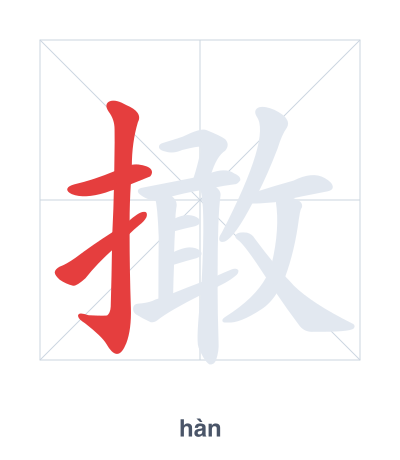
Open Hanzi Writer to see the animated stroke order and practice writing 撖 with real-time feedback.
The character 撖 (hàn) is written with 14 strokes. Follow the standard Chinese stroke order: top to bottom, left to right, outside before inside. The radical 扌 is one of its key components.
Practice the correct stroke order with the Hanzi Writer app to see animated stroke-by-stroke guidance with real-time feedback.
撖 means to roll out (dough).
撖 is a compound character with the hand radical 扌 indicating an action, and 敢 (gǎn, meaning 'brave' or 'daring') providing phonetic cues. The combination suggests using one's hand boldly to press and roll dough outward, linking directly to the meaning 'to roll out (dough)'.
💡 Memory Tip: Imagine a brave chef (敢) using his strong hand (扌) to flatten a stubborn lump of dough into a perfect circle.
奶奶在厨房撖面。
nǎi nǎi zài chú fáng hàn miàn
Grandma is rolling out dough in the kitchen.
撖面杖在桌子上。
hàn miàn zhàng zài zhuō zi shàng
The rolling pin is on the table.
他在撖饺子皮。
tā zài hàn jiǎo zi pí
He is rolling out dumpling wrappers.
Open Hanzi Writer to see the animated stroke order and practice writing 撖 with real-time feedback.
✨ Animated stroke order · Handwriting recognition · HSK-graded practice · Free to use
撖 consists of the hand radical 扌 on the left, which shows the action involves the hand, and 敢 on the right, which gives the pronunciation hàn. The hand radical connects directly to the meaning of physically rolling out dough using a rolling pin.