杖 (zhàng) means "walking stick" in Chinese. It has 7 strokes with the radical 木, and is HSK Level 7.
Rated 3.5/5 in difficulty (challenging).
Harder than 18% of HSK Level 7 characters.
Appears in 3+ common words including 拐杖 (guǎi zhàng), 手杖 (shǒu zhàng), 拄杖 (zhǔ zhàng).
Due to its 7 strokes, Hanzi Writer's error detection shows 杖 requires focused practice — most learners need 10+ attempts for consistent accuracy.
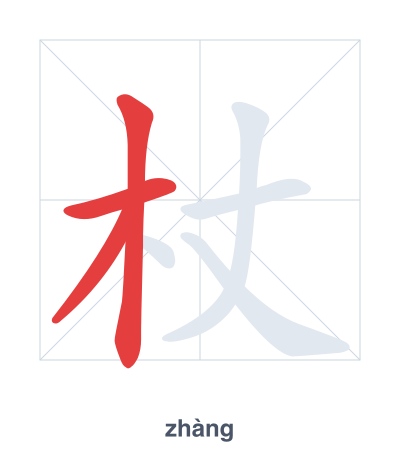
Open Hanzi Writer to see the animated stroke order and practice writing 杖 with real-time feedback.
The character 杖 (zhàng) is written with 7 strokes. Follow the standard Chinese stroke order: top to bottom, left to right, outside before inside. The radical 木 is one of its key components.
Practice the correct stroke order with the Hanzi Writer app to see animated stroke-by-stroke guidance with real-time feedback.
杖 means walking stick.
As an HSK Level 7 character, 杖 is an intermediate-level character.
杖 combines the radical 木 (wood) with 丈, an ancient pictograph of a hand holding a stick. Together they depict a wooden stick held in hand, originally used for support or as a measuring tool—hence 'walking stick'.
💡 Memory Tip: Imagine a wooden staff (木) exactly one 丈 (an old unit of length) tall, perfect for leaning on while walking.
爷爷走路用拐杖。
yé yé zǒu lù yòng guǎi zhàng
Grandpa uses a cane to walk.
这根手杖是木头的。
zhè gēn shǒu zhàng shì mù tou de
This walking stick is made of wood.
他拄杖慢慢地走。
tā zhǔ zhàng màn màn dì zǒu
He walked slowly with a cane.
Open Hanzi Writer to see the animated stroke order and practice writing 杖 with real-time feedback.
✨ Animated stroke order · Handwriting recognition · HSK-graded practice · Free to use
杖 is made of two parts: the left side is 木 (wood) and the right side is 丈 (a unit of length). Since walking sticks are traditionally made of wood and are about one 丈 (roughly 3.3 meters) long, the combination directly represents a wooden walking stick.