帼 (guó) means "Women's headgear / Heroine" in Chinese. It has 11 strokes with the radical 巾.
Rated 4.2/5 in difficulty (advanced).
Appears in 3+ common words including 巾帼 (jīn guó), 帼英 (guó yīng), 巾帼气 (jīn guó qì).
Due to its 11 strokes, Hanzi Writer's error detection shows 帼 requires focused practice — most learners need 10+ attempts for consistent accuracy.
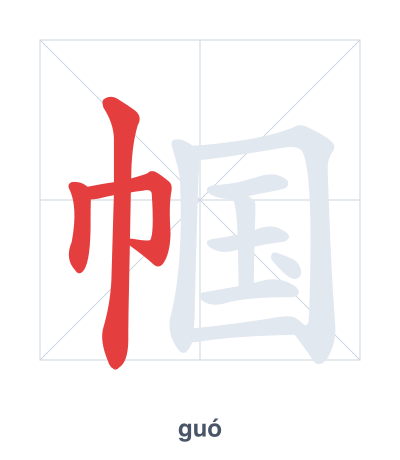
Open Hanzi Writer to see the animated stroke order and practice writing 帼 with real-time feedback.
The character 帼 (guó) is written with 11 strokes. Follow the standard Chinese stroke order: top to bottom, left to right, outside before inside. The radical 巾 is one of its key components.
Practice the correct stroke order with the Hanzi Writer app to see animated stroke-by-stroke guidance with real-time feedback.
帼 means Women's headgear / Heroine.
Combines the radical 巾 (cloth, headgear) with 國 (country) as a phonetic component. Originally referred to a woman's headdress; later extended to mean 'heroine' through the term 巾帼 (woman's headgear) symbolizing female warriors.
💡 Memory Tip: Picture a heroine (巾帼) wearing a headscarf (巾) that has a map of the country (國) printed on it.
她是巾帼英雄。
tā shì jīn guó yīng xióng
She is a heroine.
赞美帼英的诗。
zàn měi guó yīng de shī
A poem praising Guoying.
她很有巾帼气。
tā hěn yǒu jīn guó qì
She has a heroic spirit.
Open Hanzi Writer to see the animated stroke order and practice writing 帼 with real-time feedback.
✨ Animated stroke order · Handwriting recognition · HSK-graded practice · Free to use
The character 帼 has the radical 巾 (cloth) on the left, and the right component is 国 (country). The 巾 radical connects it to headgear or cloth items, while 国 hints at national or heroic contexts. Together, the character originally meant a woman's head covering, later extended to mean 'heroine' or 'female warrior'.