绲 (gǔn) means "To bind; to hem; cord; braid" in Chinese. It has 11 strokes with the radical 纟.
Rated 4.2/5 in difficulty (advanced).
Appears in 3+ common words including 绲边 (gǔn biān), 绲条 (gǔn tiáo), 绲带 (gǔn dài).
Due to its 11 strokes, Hanzi Writer's error detection shows 绲 requires focused practice — most learners need 10+ attempts for consistent accuracy.
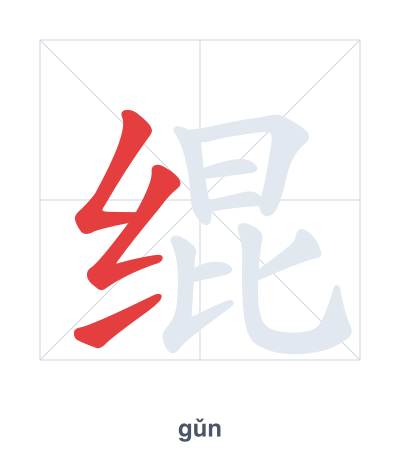
Open Hanzi Writer to see the animated stroke order and practice writing 绲 with real-time feedback.
The character 绲 (gǔn) is written with 11 strokes. Follow the standard Chinese stroke order: top to bottom, left to right, outside before inside. The radical 纟 is one of its key components.
Practice the correct stroke order with the Hanzi Writer app to see animated stroke-by-stroke guidance with real-time feedback.
绲 means To bind; to hem; cord; braid.
绲 is a phono-semantic compound with the silk radical 纟 (thread) indicating it relates to textiles, and the phonetic component 昆 (kūn, elder brother) providing the pronunciation gǔn. The character originally meant a type of cord or braid, and later came to mean to bind or hem fabric.
💡 Memory Tip: Imagine a silk thread (纟) wrapping around a squarish bundle (昆) to bind it tightly into a hem.
衣服的绲边很精致。
yī fú de gǔn biān hěn jīng zhì
The piping on the clothes is very delicate.
这条绲条是红色的。
zhè tiáo gǔn tiáo shì hóng sè de
This piping is red.
绲带可以加固衣服。
gǔn dài kě yǐ jiā gù yī fú
Piping can reinforce clothing.
Open Hanzi Writer to see the animated stroke order and practice writing 绲 with real-time feedback.
✨ Animated stroke order · Handwriting recognition · HSK-graded practice · Free to use
绲 is a left-right character. The left side 纟 (silk radical) tells you the meaning is related to thread or cloth. The right side 昆 gives the pronunciation gǔn and connects to the idea of binding or braiding threads together.