刽 (guì) means "to cut; to execute" in Chinese. It has 8 strokes with the radical 刂.
Rated 3.4/5 in difficulty (challenging).
Appears in 1+ common words including 刽子手 (guì zi shǒu).
Due to its 8 strokes, Hanzi Writer's error detection shows 刽 requires focused practice — most learners need 10+ attempts for consistent accuracy.
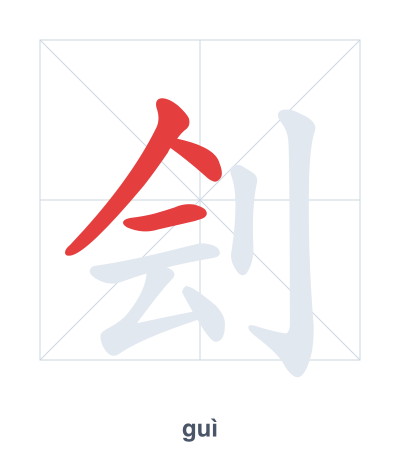
Open Hanzi Writer to see the animated stroke order and practice writing 刽 with real-time feedback.
The character 刽 (guì) is written with 8 strokes. Follow the standard Chinese stroke order: top to bottom, left to right, outside before inside. The radical 刂 is one of its key components.
Practice the correct stroke order with the Hanzi Writer app to see animated stroke-by-stroke guidance with real-time feedback.
刽 means to cut; to execute.
刽 is a phono-semantic compound: the radical 刂 (knife) indicates the meaning relates to cutting or execution, while the component 会 (huì) provides the pronunciation (guì). The character visually shows a knife (刂) paired with a phonetic element, representing the act of beheading or carrying out a death sentence.
💡 Memory Tip: Picture a 'meeting' (会) where a big knife (刂) is used to 'execute' someone—cutting the meeting short forever.
刽子手举起了大刀。
guì zi shǒu jǔ qǐ le dà dāo
The executioner raised the broadsword.
这是一个刽子手的故事。
zhè shì yí gè guì zi shǒu de gù shì
This is a story of an executioner.
他在电影里演刽子手。
tā zài diàn yǐng lǐ yǎn guì zi shǒu
He plays an executioner in the movie.
Open Hanzi Writer to see the animated stroke order and practice writing 刽 with real-time feedback.
✨ Animated stroke order · Handwriting recognition · HSK-graded practice · Free to use
刽 is a left-right character. The left part 会 (huì) provides the pronunciation while the right radical 刂 (knife) indicates cutting action. Together they form a character meaning 'to cut' or 'to execute.'