槁 (gǎo) means "Withered" in Chinese. It has 14 strokes with the radical 木.
Rated 4.2/5 in difficulty (advanced).
Appears in 3+ common words including 枯槁 (kū gǎo), 槁木 (gǎo mù), 槁死 (gǎo sǐ).
Due to its 14 strokes, Hanzi Writer's error detection shows 槁 requires focused practice — most learners need 10+ attempts for consistent accuracy.
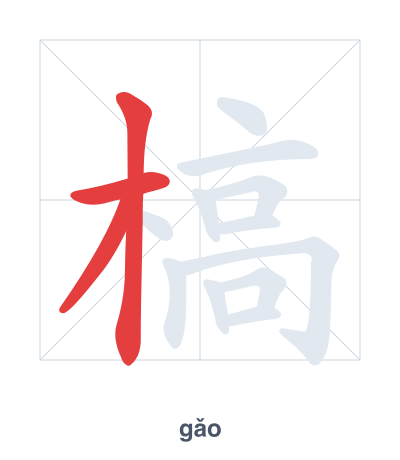
Open Hanzi Writer to see the animated stroke order and practice writing 槁 with real-time feedback.
The character 槁 (gǎo) is written with 14 strokes. Follow the standard Chinese stroke order: top to bottom, left to right, outside before inside. The radical 木 is one of its key components.
Practice the correct stroke order with the Hanzi Writer app to see animated stroke-by-stroke guidance with real-time feedback.
槁 means Withered.
槁 is a phono-semantic compound combining the tree radical 木 (tree) with the phonetic component 高 (gāo, tall/high), suggesting a tree that is tall but dried out and withered.
💡 Memory Tip: Picture a tall tree (木 + 高) whose bark is peeling off and leaves are all gone, standing like a withered skeleton in a barren field.
他的面色十分枯槁。
tā de miàn sè shí fēn kū gǎo
His complexion is very haggard.
槁木不可雕也。
gǎo mù bù kě diāo yě
Rotten wood cannot be carved.
这里的植物快槁死了。
zhè lǐ de zhí wù kuài gǎo sǐ le
The plants here are almost withered and dead.
Open Hanzi Writer to see the animated stroke order and practice writing 槁 with real-time feedback.
✨ Animated stroke order · Handwriting recognition · HSK-graded practice · Free to use
槁 is made of two parts: the left radical 木 (wood/tree) and the right part 高 (gāo, meaning tall). The character is a pictophonetic compound where 木 gives the meaning related to trees and 高 provides the pronunciation. Together, they suggest a tall tree that has become dry and withered.