擀 (gǎn) means "to roll (dough) with a rolling pin" in Chinese. It has 16 strokes with the radical 扌.
Rated 4.2/5 in difficulty (advanced).
Appears in 3+ common words including 擀面 (gǎn miàn), 擀皮 (gǎn pí), 擀平 (gǎn píng).
Due to its 16 strokes, Hanzi Writer's error detection shows 擀 requires focused practice — most learners need 10+ attempts for consistent accuracy.
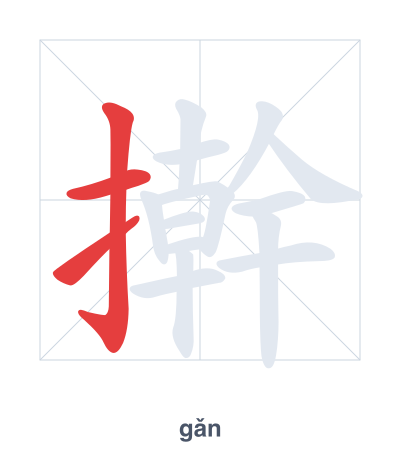
Open Hanzi Writer to see the animated stroke order and practice writing 擀 with real-time feedback.
The character 擀 (gǎn) is written with 16 strokes. Follow the standard Chinese stroke order: top to bottom, left to right, outside before inside. The radical 扌 is one of its key components.
Practice the correct stroke order with the Hanzi Writer app to see animated stroke-by-stroke guidance with real-time feedback.
擀 means to roll (dough) with a rolling pin.
This character is a phono-semantic compound: the radical 扌 (hand) indicates the action is performed by hand, and the component 旱 (hàn, meaning 'dry' but here purely phonetic) contributes the approximate sound gǎn. Together, they depict the hand movement of rolling dough flat with a rolling pin.
💡 Memory Tip: Imagine your hand (扌) rolling a dry (旱) lump of dough into a thin, flat circle for making tortillas.
奶奶在厨房擀面。
nǎi nǎi zài chú fáng gǎn miàn
Grandma is rolling out dough in the kitchen.
妈妈负责擀饺子皮。
mā mā fù zé gǎn jiǎo zi pí
Mom is in charge of rolling out dumpling wrappers.
把面团擀平一点。
bǎ miàn tuán gǎn píng yì diǎn
Roll the dough a bit flatter.
Open Hanzi Writer to see the animated stroke order and practice writing 擀 with real-time feedback.
✨ Animated stroke order · Handwriting recognition · HSK-graded practice · Free to use
The character 擀 is made of two parts: the left radical 扌 (hand) and the right part 幹 (gàn, meaning trunk or to do). The hand radical shows that the action involves using your hands, while 幹 provides the pronunciation gǎn and hints at the motion of pressing and rolling, just like rolling dough.