驸 (fù) means "extra horse; emperor's son-in-law" in Chinese. It has 8 strokes with the radical 马.
Rated 3.7/5 in difficulty (challenging).
Appears in 3+ common words including 驸马 (fù mǎ), 驸马爷 (fù mǎ yé), 驸马府 (fù mǎ fǔ).
Due to its 8 strokes, Hanzi Writer's error detection shows 驸 requires focused practice — most learners need 10+ attempts for consistent accuracy.
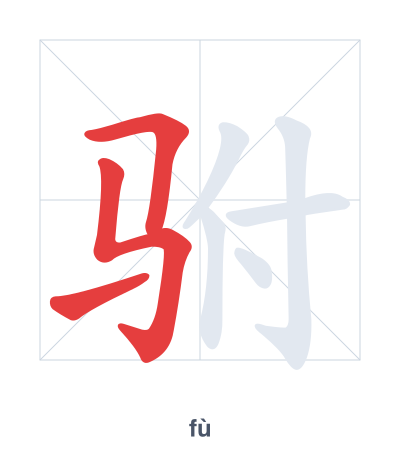
Open Hanzi Writer to see the animated stroke order and practice writing 驸 with real-time feedback.
The character 驸 (fù) is written with 8 strokes. Follow the standard Chinese stroke order: top to bottom, left to right, outside before inside. The radical 马 is one of its key components.
Practice the correct stroke order with the Hanzi Writer app to see animated stroke-by-stroke guidance with real-time feedback.
驸 means extra horse; emperor's son-in-law.
驸 is a compound of 马 (horse) and 付 (to attach), literally meaning an extra horse that is attached to a carriage. This term evolved to refer to the emperor's son-in-law, who originally rode a spare horse in the imperial procession.
💡 Memory Tip: Picture a horse (马) carrying the emperor's son-in-law as he pays (付) a formal visit to the palace.
他在戏里演一位驸马。
tā zài xì lǐ yǎn yī wèi fù mǎ
He plays the role of a princess's husband in the play.
大家都叫他驸马爷。
dà jiā dōu jiào tā fù mǎ yé
Everyone calls him the Emperor's son-in-law.
这里以前是驸马府。
zhè lǐ yǐ qián shì fù mǎ fǔ
This place used to be the residence of the emperor's son-in-law.
Open Hanzi Writer to see the animated stroke order and practice writing 驸 with real-time feedback.
✨ Animated stroke order · Handwriting recognition · HSK-graded practice · Free to use
驸 is composed of the radical 马 (horse) on the left and the phonetic component 付 on the right. The radical hints at the meaning related to horses, while 付 provides the pronunciation fù. Historically, 驸 referred to an extra horse for a carriage, which later became the title for the emperor's son-in-law, who rode such a horse.