蝠 (fú) means "Bat (character component)" in Chinese. It has 15 strokes with the radical 虫.
Rated 4.2/5 in difficulty (advanced).
Appears in 3+ common words including 蝙蝠 (biān fú), 蝠鲼 (fú fèn), 蝙蝠群 (biān fú qún).
Due to its 15 strokes, Hanzi Writer's error detection shows 蝠 requires focused practice — most learners need 10+ attempts for consistent accuracy.
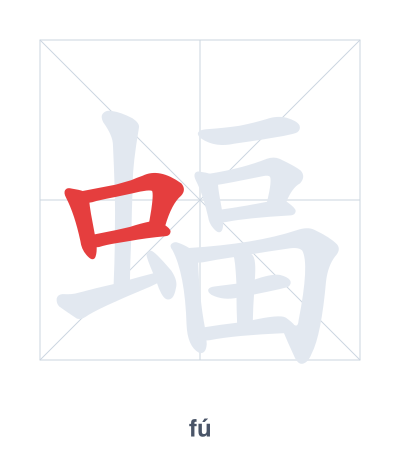
Open Hanzi Writer to see the animated stroke order and practice writing 蝠 with real-time feedback.
The character 蝠 (fú) is written with 15 strokes. Follow the standard Chinese stroke order: top to bottom, left to right, outside before inside. The radical 虫 is one of its key components.
Practice the correct stroke order with the Hanzi Writer app to see animated stroke-by-stroke guidance with real-time feedback.
蝠 means Bat (character component).
蝠 is a compound character with the radical 虫 (insect/creature) indicating that bats were classified as winged insects in ancient Chinese thought, and the phonetic component 畐 (fú) provides the sound. The top part of 畐 resembles a bat's head and folded wings, while the bottom suggests its body hanging upside down.
💡 Memory Tip: Picture a bat (蝠) as a creepy bug (虫) that wraps its wings around a square cloth (畐) to stay hidden while sleeping upside down.
蝙蝠在夜里飞行。
biān fú zài yè lǐ fēi xíng
Bats fly at night.
这种鱼叫蝠鲼。
zhè zhǒng yú jiào fú fèn
This kind of fish is called a manta ray.
蝙蝠不是鸟类。
biān fú bú shì niǎo lèi
Bats are not birds.
Open Hanzi Writer to see the animated stroke order and practice writing 蝠 with real-time feedback.
✨ Animated stroke order · Handwriting recognition · HSK-graded practice · Free to use
蝠 is composed of the radical 虫 (insect/worm) on the left and 畐 (fú) on the right. The radical 虫 indicates the character relates to a creature, while the phonetic component 畐 gives the pronunciation fú.