燔 (fán) means "To burn / To roast" in Chinese. It has 16 strokes with the radical 火.
Rated 4.2/5 in difficulty (advanced).
Appears in 3+ common words including 燔祭 (fán jì), 燔烧 (fán shāo), 燔炙 (fán zhì).
Due to its 16 strokes, Hanzi Writer's error detection shows 燔 requires focused practice — most learners need 10+ attempts for consistent accuracy.
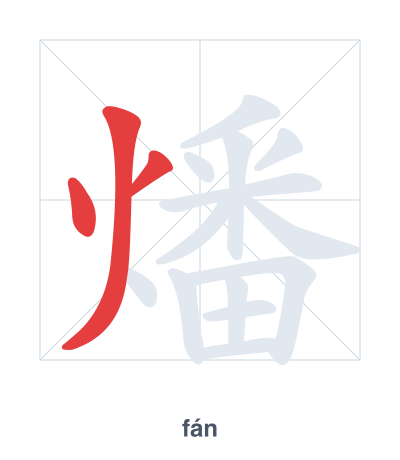
Open Hanzi Writer to see the animated stroke order and practice writing 燔 with real-time feedback.
The character 燔 (fán) is written with 16 strokes. Follow the standard Chinese stroke order: top to bottom, left to right, outside before inside. The radical 火 is one of its key components.
Practice the correct stroke order with the Hanzi Writer app to see animated stroke-by-stroke guidance with real-time feedback.
燔 means To burn / To roast.
燔 combines the radical 火 (fire) with the phonetic component 番 (fān, meaning 'turn' or 'repeat'). The fire radical indicates the character's connection to burning or roasting, while 番 suggests the repeated turning of meat over a flame, evoking the process of roasting evenly.
💡 Memory Tip: Imagine a chef turning a skewer of meat (番) over a blazing fire (火) to roast it perfectly — that's 燔.
古代有燔祭的习俗。
gǔ dài yǒu fán jì de xí sú
There was a custom of burnt offerings in ancient times.
这里的草被燔烧了。
zhè lǐ de cǎo bèi fán shāo le
The grass here has been burned.
燔炙的肉味道很香。
fán zhì de ròu wèi dào hěn xiāng
The roasted meat smells delicious.
Open Hanzi Writer to see the animated stroke order and practice writing 燔 with real-time feedback.
✨ Animated stroke order · Handwriting recognition · HSK-graded practice · Free to use
燔 is composed of the fire radical 火 (also written as 灬) on the left, and the phonetic component 番 on the right. The fire radical clearly links to the character's meanings of burning or roasting, while 番 contributes pronunciation (fán) but not meaning.