幡 (fān) means "banner / streamer" in Chinese. It has 15 strokes with the radical 巾.
Rated 4.2/5 in difficulty (advanced).
Appears in 3+ common words including 幡旗 (fān qí), 幡然 (fān rán), 挂幡 (guà fān).
Due to its 15 strokes, Hanzi Writer's error detection shows 幡 requires focused practice — most learners need 10+ attempts for consistent accuracy.
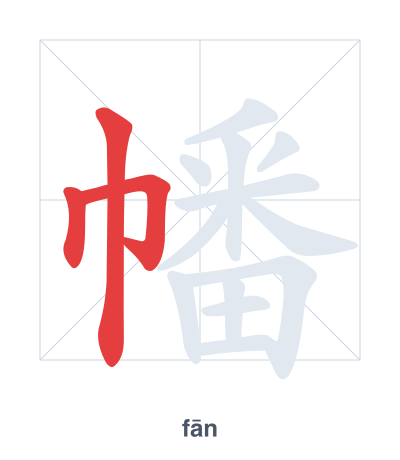
Open Hanzi Writer to see the animated stroke order and practice writing 幡 with real-time feedback.
The character 幡 (fān) is written with 15 strokes. Follow the standard Chinese stroke order: top to bottom, left to right, outside before inside. The radical 巾 is one of its key components.
Practice the correct stroke order with the Hanzi Writer app to see animated stroke-by-stroke guidance with real-time feedback.
幡 means banner / streamer.
幡 is a phono-semantic compound: the left side 巾 (cloth) indicates it's a fabric object like a banner, while the right side 番 (fān) provides the sound and suggests something turned or fluttering, as banners twist in the wind. Ancient banners were long strips of cloth attached to poles, used in processions or as military signals.
💡 Memory Tip: Picture a cloth banner (巾) with colorful patterns (like the repetitive strokes in 番) flapping wildly as it turns and twists in the wind — that's 幡.
风吹动了彩色的幡旗。
fēng chuī dòng le cǎi sè de fān qí
The wind blew the colorful banners.
他幡然醒悟,决定努力。
tā fān rán xǐng wù jué dìng nǔ lì
He suddenly saw the light and decided to work hard.
寺庙门口挂着长幡。
sì miào mén kǒu guà zhe zhǎng fān
Long banners are hanging at the temple entrance.
Open Hanzi Writer to see the animated stroke order and practice writing 幡 with real-time feedback.
✨ Animated stroke order · Handwriting recognition · HSK-graded practice · Free to use
The character 幡 combines the radical 巾 (cloth) on the left with the phonetic component 番 on the right. The 巾 radical indicates the meaning relates to cloth or fabric, while 番 provides pronunciation (fān). Together, they form a character meaning a cloth banner or streamer.