垡 (fá) means "to plow; turned-over soil" in Chinese. It has 9 strokes with the radical 土.
Rated 4/5 in difficulty (challenging).
Appears in 3+ common words including 翻垡 (fān fá), 垡子 (fá zi), 耕垡 (gēng fá).
Due to its 9 strokes, Hanzi Writer's error detection shows 垡 requires focused practice — most learners need 10+ attempts for consistent accuracy.
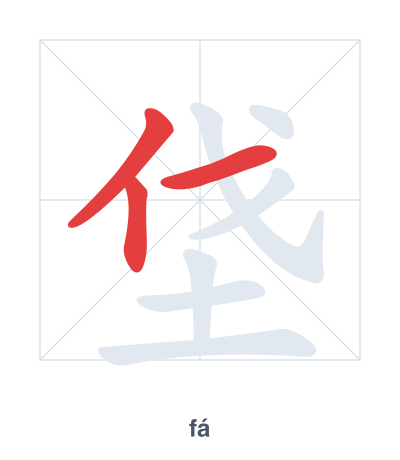
Open Hanzi Writer to see the animated stroke order and practice writing 垡 with real-time feedback.
The character 垡 (fá) is written with 9 strokes. Follow the standard Chinese stroke order: top to bottom, left to right, outside before inside. The radical 土 is one of its key components.
Practice the correct stroke order with the Hanzi Writer app to see animated stroke-by-stroke guidance with real-time feedback.
垡 means to plow; turned-over soil.
垡 combines the radical 土 (earth) with 伐 (to cut/strike), depicting the action of cutting into the soil to turn it over for plowing.
💡 Memory Tip: Imagine a farmer using a broadsword (伐) to slice through the soil (土), flipping it over into neat furrows.
农民在田里翻垡。
nóng mín zài tián lǐ fān fá
Farmers are turning over the soil clods in the field.
土块碎成了垡子。
tǔ kuài suì chéng le fá zi
The clods of earth broke into smaller pieces.
春天是耕垡的季节。
chūn tiān shì gēng fá de jì jié
Spring is the season for plowing the fields.
Open Hanzi Writer to see the animated stroke order and practice writing 垡 with real-time feedback.
✨ Animated stroke order · Handwriting recognition · HSK-graded practice · Free to use
垡 is composed of the radical 土 (earth) on the left and 伐 (fá, to cut) on the right. The radical 土 connects it to soil, while 伐 suggests the action of cutting or turning, together meaning to plow or turn over soil.