摁 (èn) means "press / push" in Chinese. It has 13 strokes with the radical 扌.
Rated 4.2/5 in difficulty (advanced).
Appears in 3+ common words including 摁铃 (èn líng), 摁住 (èn zhù), 摁电梯 (èn diàn tī).
Due to its 13 strokes, Hanzi Writer's error detection shows 摁 requires focused practice — most learners need 10+ attempts for consistent accuracy.
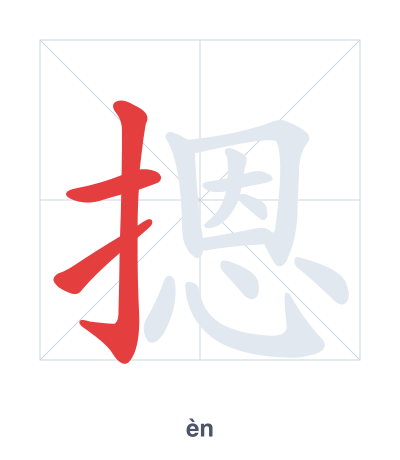
Open Hanzi Writer to see the animated stroke order and practice writing 摁 with real-time feedback.
The character 摁 (èn) is written with 13 strokes. Follow the standard Chinese stroke order: top to bottom, left to right, outside before inside. The radical 扌 is one of its key components.
Practice the correct stroke order with the Hanzi Writer app to see animated stroke-by-stroke guidance with real-time feedback.
摁 means press / push.
摁 is composed of the hand radical 扌 on the left and the phonetic component 恩 (ēn) on the right. The hand radical indicates that the action involves the hand, while 恩 provides the sound and adds a sense of pressing down firmly, like a gesture of gratitude pressing a button.
💡 Memory Tip: Imagine pressing a doorbell with your finger while saying '恩' (thank you) to the host — you '摁' the bell to show thanks.
请摁一下门铃。
qǐng èn yī xià mén líng
Please press the doorbell.
用手摁住纸张。
yòng shǒu èn zhù zhǐ zhāng
Press down on the paper with your hand.
帮我摁一下电梯。
bāng wǒ èn yī xià diàn tī
Help me press the elevator button.
Open Hanzi Writer to see the animated stroke order and practice writing 摁 with real-time feedback.
✨ Animated stroke order · Handwriting recognition · HSK-graded practice · Free to use
The left part 扌 (hand radical) shows that the action is done with the hand. The right part 恩 (ēn) gives the sound and hints at a firm, downward press, like when you press a button to express gratitude. Together, they create the meaning of pressing or pushing with your hand.