愕 (è) means "stunned / startled" in Chinese. It has 12 strokes with the radical 忄.
Rated 4.2/5 in difficulty (advanced).
Appears in 3+ common words including 惊愕 (jīng è), 愕然 (è rán), 错愕 (cuò è).
Due to its 12 strokes, Hanzi Writer's error detection shows 愕 requires focused practice — most learners need 10+ attempts for consistent accuracy.
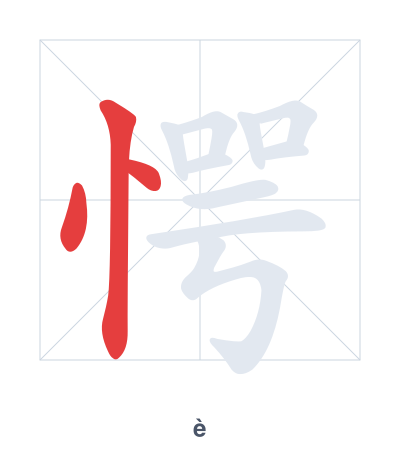
Open Hanzi Writer to see the animated stroke order and practice writing 愕 with real-time feedback.
The character 愕 (è) is written with 12 strokes. Follow the standard Chinese stroke order: top to bottom, left to right, outside before inside. The radical 忄 is one of its key components.
Practice the correct stroke order with the Hanzi Writer app to see animated stroke-by-stroke guidance with real-time feedback.
愕 means stunned / startled.
愕 combines the heart radical (忄) with 咢 (è), which originally depicted two mouths open wide in alarm—like a gasp of surprise. Together, the character shows a heart startled into stunned silence, as if suddenly shocked by unexpected news.
💡 Memory Tip: Picture two mouths (咢) screaming in shock while a heart (忄) freezes—you're so stunned you can't even move.
大家都感到很惊愕。
dà jiā dōu gǎn dào hěn jīng è
Everyone felt very stunned.
他愕然地看着我。
tā è rán dì kàn zhe wǒ
He looked at me in astonishment.
消息让人感到错愕。
xiāo xī ràng rén gǎn dào cuò è
The news leaves people stunned.
Open Hanzi Writer to see the animated stroke order and practice writing 愕 with real-time feedback.
✨ Animated stroke order · Handwriting recognition · HSK-graded practice · Free to use
The left side is the radical 忄 (heart), which shows this character is related to emotions or feelings. The right side is 咢 (è), which provides the pronunciation and also suggests the idea of being startled or shocked, like a sudden surprise. Together, they mean 'stunned' or 'startled' as a strong emotional reaction.