屙 (ē) means "To defecate." in Chinese. It has 10 strokes with the radical 尸.
Rated 4.2/5 in difficulty (advanced).
Appears in 3+ common words including 屙屎 (ē shǐ), 屙尿 (ē niào), 屙肚子 (ē dǔ zi).
Due to its 10 strokes, Hanzi Writer's error detection shows 屙 requires focused practice — most learners need 10+ attempts for consistent accuracy.
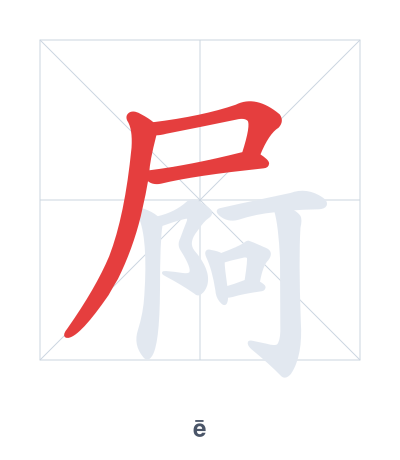
Open Hanzi Writer to see the animated stroke order and practice writing 屙 with real-time feedback.
The character 屙 (ē) is written with 10 strokes. Follow the standard Chinese stroke order: top to bottom, left to right, outside before inside. The radical 尸 is one of its key components.
Practice the correct stroke order with the Hanzi Writer app to see animated stroke-by-stroke guidance with real-time feedback.
屙 means To defecate..
屙 is a phono-semantic compound. The radical 尸 (body/corpse) represents the physical act of defecation, while 阿 (ē) serves as the phonetic component indicating pronunciation. Together, they depict the bodily process of expelling waste.
💡 Memory Tip: Imagine a body (尸) letting out a relieved 'Ah' (阿) as it defecates.
小孩在路边屙屎。
xiǎo hái zài lù biān ē shǐ
The child is pooping by the roadside.
别在这里乱屙尿。
bié zài zhè lǐ luàn ē niào
Don't relieve yourself here.
他今天有点屙肚子。
tā jīn tiān yǒu diǎn ē dǔ zi
He has a bit of diarrhea today.
Open Hanzi Writer to see the animated stroke order and practice writing 屙 with real-time feedback.
✨ Animated stroke order · Handwriting recognition · HSK-graded practice · Free to use
The character 屙 is composed of the radical 尸 (corpse or body) and the phonetic component 阿 (ē). The 尸 radical suggests a connection to the body or bodily functions, while 阿 hints at the pronunciation ē. Together, they form a character meaning to defecate.