跺 (duò) means "To stamp (one's foot)." in Chinese. It has 13 strokes with the radical 足.
Rated 4.2/5 in difficulty (advanced).
Appears in 3+ common words including 跺脚 (duò jiǎo), 跺了一下 (duò le yī xià), 跺泥 (duò ní).
Due to its 13 strokes, Hanzi Writer's error detection shows 跺 requires focused practice — most learners need 10+ attempts for consistent accuracy.
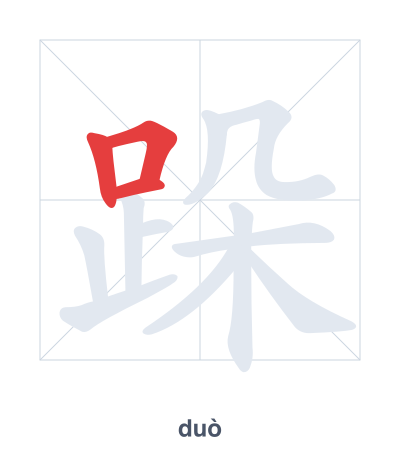
Open Hanzi Writer to see the animated stroke order and practice writing 跺 with real-time feedback.
The character 跺 (duò) is written with 13 strokes. Follow the standard Chinese stroke order: top to bottom, left to right, outside before inside. The radical 足 is one of its key components.
Practice the correct stroke order with the Hanzi Writer app to see animated stroke-by-stroke guidance with real-time feedback.
跺 means To stamp (one's foot)..
The character 跺 is a compound of the radical 足 (foot) and the phonetic component 朵 (duǒ, 'ear' or 'cluster'). The foot radical indicates the action involves the feet, while 朵 provides pronunciation—together they depict the foot coming down heavily, like stamping.
💡 Memory Tip: Picture a foot (足) stomping on a pile of flowers (朵), crushing them with a loud stamp.
他气得直跺脚。
tā qì dé zhí duò jiǎo
He was so angry that he kept stomping his feet.
他用力跺了一下地。
tā yòng lì duò le yī xià dì
He stomped his foot hard on the ground.
进屋前先跺跺泥。
jìn wū qián xiān duò duò ní
Stomp the mud off your feet before entering the house.
Open Hanzi Writer to see the animated stroke order and practice writing 跺 with real-time feedback.
✨ Animated stroke order · Handwriting recognition · HSK-graded practice · Free to use
The left side is the radical 足, which means "foot" and indicates the character relates to foot actions. The right side 朵 originally means "flower" or "ear" but here mainly provides the pronunciation clue, as 跺 sounds like duò.