胴 (dòng) means "torso; carcass" in Chinese. It has 10 strokes with the radical 月.
Rated 4.2/5 in difficulty (advanced).
Appears in 3+ common words including 胴体 (dòng tǐ), 胴部 (dòng bù), 猪胴体 (zhū dòng tǐ).
Due to its 10 strokes, Hanzi Writer's error detection shows 胴 requires focused practice — most learners need 10+ attempts for consistent accuracy.
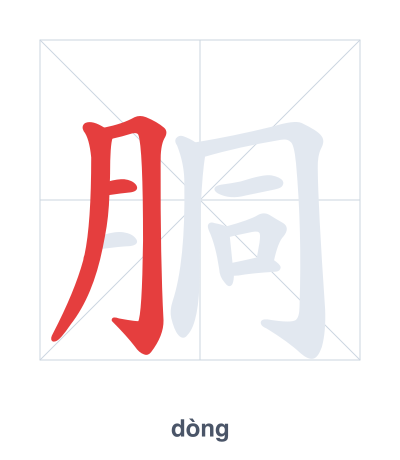
Open Hanzi Writer to see the animated stroke order and practice writing 胴 with real-time feedback.
The character 胴 (dòng) is written with 10 strokes. Follow the standard Chinese stroke order: top to bottom, left to right, outside before inside. The radical 月 is one of its key components.
Practice the correct stroke order with the Hanzi Writer app to see animated stroke-by-stroke guidance with real-time feedback.
胴 means torso; carcass.
胴 is a compound character with the flesh radical 月 (⺼) indicating the body, and 同 (tóng, 'same') providing the sound. The meaning 'torso' or 'carcass' comes from the body radical applied to the idea of a central, uniform trunk that is 'the same' in structure for many animals.
💡 Memory Tip: Picture a dissection table where all human torsos look exactly the same (同) when stripped of skin—hence 月 (flesh) + 同 = 胴.
雕塑展现了胴体美。
diāo sù zhǎn xiàn le dòng tǐ měi
The sculpture shows the beauty of the human body.
胴部指人的躯干。
dòng bù zhǐ rén de qū gàn
The 'dong' part refers to the human torso.
厨房里有猪胴体。
chú fáng lǐ yǒu zhū dòng tǐ
There is a pig carcass in the kitchen.
Open Hanzi Writer to see the animated stroke order and practice writing 胴 with real-time feedback.
✨ Animated stroke order · Handwriting recognition · HSK-graded practice · Free to use
The character 胴 combines the radical 月 (月字旁), which indicates body parts, with 同 (tóng), which provides pronunciation. The radical 月 shows that the character relates to the body, while 同 is a phonetic component, making the character mean 'torso' or 'carcass'.