胨 (dòng) means "peptone" in Chinese. It has 9 strokes with the radical 月.
Rated 4/5 in difficulty (challenging).
Appears in 3+ common words including 蛋白胨 (dàn bái dòng), 胨化 (dòng huà), 胨液 (dòng yè).
Due to its 9 strokes, Hanzi Writer's error detection shows 胨 requires focused practice — most learners need 10+ attempts for consistent accuracy.
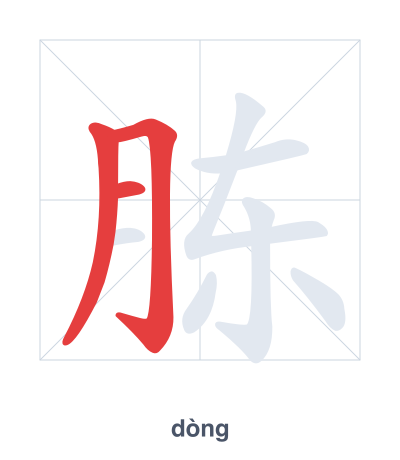
Open Hanzi Writer to see the animated stroke order and practice writing 胨 with real-time feedback.
The character 胨 (dòng) is written with 9 strokes. Follow the standard Chinese stroke order: top to bottom, left to right, outside before inside. The radical 月 is one of its key components.
Practice the correct stroke order with the Hanzi Writer app to see animated stroke-by-stroke guidance with real-time feedback.
胨 means peptone.
This is a modern phono-semantic compound character. The radical 月 (flesh/meat) indicates it relates to bodily substances, while 东 (dōng, east) provides the phonetic component dòng. The meaning 'peptone' (a protein derivative) was assigned in scientific vocabulary, linking the flesh radical to organic compounds.
💡 Memory Tip: Imagine a chunk of meat (月) left in the east (东) to rot, producing peptone—a smelly but useful protein breakdown product.
实验需要蛋白胨。
shí yàn xū yào dàn bái dòng
The experiment requires peptone.
物质开始胨化了。
wù zhì kāi shǐ dòng huà le
The substance has begun to liquefy.
试管里有胨液。
shì guǎn lǐ yǒu dòng yè
There is peptone solution in the test tube.
Open Hanzi Writer to see the animated stroke order and practice writing 胨 with real-time feedback.
✨ Animated stroke order · Handwriting recognition · HSK-graded practice · Free to use
The character 胨 has the radical 月 (meat) on the left and 东 (dōng, east) on the right. The meat radical hints that this character relates to protein or bodily substances, while 东 provides the pronunciation (dòng). Together they form a term for peptone, a protein derivative.