揲 (dié) means "to sort out; to count" in Chinese. It has 12 strokes with the radical 扌.
Rated 4.2/5 in difficulty (advanced).
Appears in 3+ common words including 揲蓍 (dié shī), 揲算 (dié suàn), 揲弄 (dié nòng).
Due to its 12 strokes, Hanzi Writer's error detection shows 揲 requires focused practice — most learners need 10+ attempts for consistent accuracy.
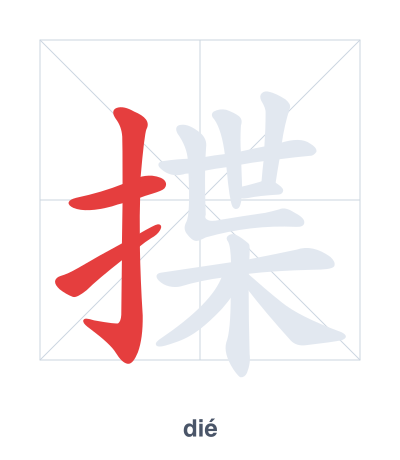
Open Hanzi Writer to see the animated stroke order and practice writing 揲 with real-time feedback.
The character 揲 (dié) is written with 12 strokes. Follow the standard Chinese stroke order: top to bottom, left to right, outside before inside. The radical 扌 is one of its key components.
Practice the correct stroke order with the Hanzi Writer app to see animated stroke-by-stroke guidance with real-time feedback.
揲 means to sort out; to count.
揲 is a phono-semantic compound: the left radical 扌 (hand) indicates an action, and the right component 枼 (yè, a thin piece or leaf) provides phonetic clues. Its ancient usage refers to sorting or counting yarrow stalks for divination, visually showing the hand manipulating thin objects.
💡 Memory Tip: Imagine your hand (扌) carefully sorting through a pile of thin leaves (枼) to count them one by one.
古人通过揲蓍占卜。
gǔ rén tōng guò dié shī zhān bo
Ancient people practiced divination by counting yarrow stalks.
他在仔细地揲算。
tā zài zǐ xì dì dié suàn
He is calculating carefully.
他在揲弄那些小棍。
tā zài dié nòng nà xiē xiǎo gùn
He is sorting those small sticks.
Open Hanzi Writer to see the animated stroke order and practice writing 揲 with real-time feedback.
✨ Animated stroke order · Handwriting recognition · HSK-graded practice · Free to use
揲 is composed of the radical 扌 (hand) on the left and 枼 (yè, a phonetic component meaning leaf or thin piece) on the right. The hand radical suggests an action done with the hands, such as sorting or counting objects. The 枼 part gives a clue about the pronunciation dié and may hint at the idea of dividing things into thin pieces, like counting stalks.