蓍 (shī) means "Yarrow" in Chinese. It has 13 strokes with the radical 艹.
Rated 4.2/5 in difficulty (advanced).
Appears in 3+ common words including 蓍草 (shī cǎo), 蓍龟 (shī guī), 蓍占 (shī zhān).
Due to its 13 strokes, Hanzi Writer's error detection shows 蓍 requires focused practice — most learners need 10+ attempts for consistent accuracy.
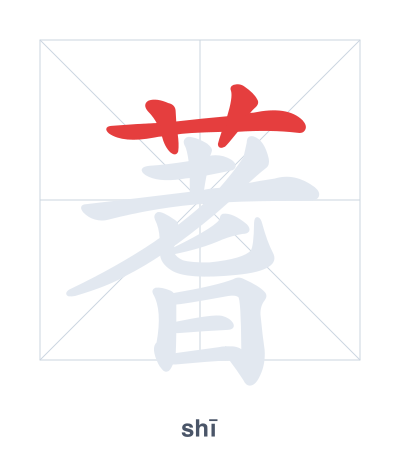
Open Hanzi Writer to see the animated stroke order and practice writing 蓍 with real-time feedback.
The character 蓍 (shī) is written with 13 strokes. Follow the standard Chinese stroke order: top to bottom, left to right, outside before inside. The radical 艹 is one of its key components.
Practice the correct stroke order with the Hanzi Writer app to see animated stroke-by-stroke guidance with real-time feedback.
蓍 means Yarrow.
蓍 is a phono-semantic compound, with the radical 艹 (grass) indicating it is a plant, and 耆 (qí, meaning 'aged' or 'old') providing the pronunciation. Yarrow was traditionally used in the ancient Chinese divination practice of the Yijing, linking the 'old' component to the plant's ancient ritual significance.
💡 Memory Tip: Picture an old sage (耆) sitting on a patch of grass (艹) meticulously counting yarrow stalks to predict the future.
蓍草是一种常见的植物。
shī cǎo shì yī zhǒng cháng jiàn de zhí wù
Yarrow is a common plant.
古人用蓍龟来占卜。
gǔ rén yòng shī guī lái zhān bǔ
Ancient people used milfoil and tortoise shells for divination.
蓍占是古代的一种习俗。
shī zhān shì gǔ dài de yī zhǒng xí sú
Yarrow divination is an ancient custom.
Open Hanzi Writer to see the animated stroke order and practice writing 蓍 with real-time feedback.
✨ Animated stroke order · Handwriting recognition · HSK-graded practice · Free to use
蓍 has the grass radical 艹 on top, indicating it is a plant, and the phonetic component 耆 below, which suggests the pronunciation shī. The grass radical directly connects to yarrow being a herb, while the bottom part primarily provides the sound.