筜 (dāng) means "a type of bamboo" in Chinese. It has 12 strokes with the radical 竹.
Rated 4.2/5 in difficulty (advanced).
Appears in 3+ common words including 筼筜 (yún dāng), 筜谷 (dāng gǔ), 筜笛 (dāng dí).
Due to its 12 strokes, Hanzi Writer's error detection shows 筜 requires focused practice — most learners need 10+ attempts for consistent accuracy.
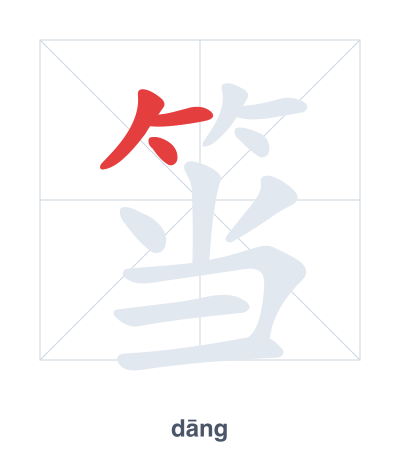
Open Hanzi Writer to see the animated stroke order and practice writing 筜 with real-time feedback.
The character 筜 (dāng) is written with 12 strokes. Follow the standard Chinese stroke order: top to bottom, left to right, outside before inside. The radical 竹 is one of its key components.
Practice the correct stroke order with the Hanzi Writer app to see animated stroke-by-stroke guidance with real-time feedback.
筜 means a type of bamboo.
筜 is a phono-semantic compound: the radical 竹 (bamboo) indicates the category, while 当 (dāng) provides the pronunciation and originally suggested the bamboo's use as a tool or stake. This character specifically refers to a type of bamboo, often used in the name 筜竹 (a kind of tall bamboo).
💡 Memory Tip: Imagine a bamboo stalk (竹) that, when struck, makes a loud 'dang' (当) sound like a gong.
这里有很多筼筜。
zhè lǐ yǒu hěn duō yún dāng
There are many tall bamboos here.
他住在筜谷。
tā zhù zài dāng gǔ
He lives in Danggu.
吹响这个筜笛。
chuī xiǎng zhè ge dāng dí
Play this bamboo flute.
Open Hanzi Writer to see the animated stroke order and practice writing 筜 with real-time feedback.
✨ Animated stroke order · Handwriting recognition · HSK-graded practice · Free to use
筜 is made of the radical 竹 (bamboo) on top and 当 (dāng) below. The bamboo radical shows this character is related to bamboo, and 当 provides the pronunciation. Together they mean a type of bamboo.