埭 (dài) means "dam / dike / earthen weir" in Chinese. It has 11 strokes with the radical 土.
Rated 4.2/5 in difficulty (advanced).
Appears in 3+ common words including 埭岸 (dài àn), 石埭 (shí dài), 埭口 (dài kǒu).
Due to its 11 strokes, Hanzi Writer's error detection shows 埭 requires focused practice — most learners need 10+ attempts for consistent accuracy.
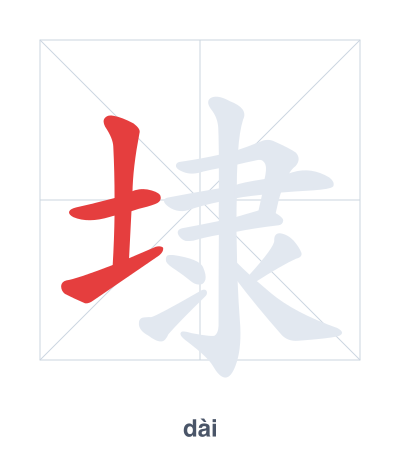
Open Hanzi Writer to see the animated stroke order and practice writing 埭 with real-time feedback.
The character 埭 (dài) is written with 11 strokes. Follow the standard Chinese stroke order: top to bottom, left to right, outside before inside. The radical 土 is one of its key components.
Practice the correct stroke order with the Hanzi Writer app to see animated stroke-by-stroke guidance with real-time feedback.
埭 means dam / dike / earthen weir.
埭 is a semantic-phonetic compound: the radical 土 (earth) indicates it relates to earthen structures, while the phonetic component 隶 (dài) provides the sound but also visually suggests a barrier. Together they form the meaning of an earthen dam or dike built to hold back water.
💡 Memory Tip: Picture a mound of earth (土) next to a tall wooden post (隶) that together block a rushing river, creating a sturdy dike.
埭岸边有很多树。
dài àn biān yǒu hěn duō shù
There are many trees along the embankment.
石埭是一个地名。
shí dài shì yí gè dì míng
Shidai is a place name.
我们在埭口集合。
wǒ men zài dài kǒu jí hé
We meet at the dike entrance.
Open Hanzi Writer to see the animated stroke order and practice writing 埭 with real-time feedback.
✨ Animated stroke order · Handwriting recognition · HSK-graded practice · Free to use
埭 is a left-right structure. The left radical 土 (earth/soil) indicates the material, while the right part 隶 (lì, meaning 'slave' but here phonetic) suggests the sound. Together, 埭 means a dam or earthen weir, which is a structure made of soil to hold back water.