垯 (da) means "mound; small hill" in Chinese. It has 9 strokes with the radical 土.
Rated 4/5 in difficulty (challenging).
Appears in 3+ common words including 垯子 (da zi), 垯地 (da dì), 山垯 (shān da).
Due to its 9 strokes, Hanzi Writer's error detection shows 垯 requires focused practice — most learners need 10+ attempts for consistent accuracy.
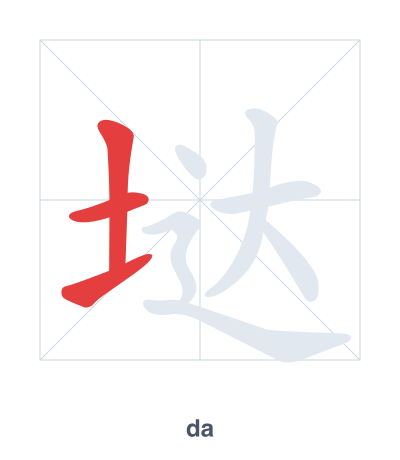
Open Hanzi Writer to see the animated stroke order and practice writing 垯 with real-time feedback.
The character 垯 (da) is written with 9 strokes. Follow the standard Chinese stroke order: top to bottom, left to right, outside before inside. The radical 土 is one of its key components.
Practice the correct stroke order with the Hanzi Writer app to see animated stroke-by-stroke guidance with real-time feedback.
垯 means mound; small hill.
垯 is a phono-semantic compound. The left radical 土 (earth) indicates that the character relates to soil or land, while the right component 达 (da, meaning 'to reach') provides the pronunciation. Together, they form the character for a mound or small hill of earth.
💡 Memory Tip: Imagine a tiny mound of earth (土) so small you can 'da' (达) across it in one step.
垯子上有许多草。
da zi shàng yǒu xǔ duō cǎo
There is a lot of grass on the small mound.
这块垯地很肥沃。
zhè kuài da dì hěn féi wò
This piece of land is very fertile.
他翻过了那座山垯。
tā fān guò le nà zuò shān da
He climbed over that hill.
Open Hanzi Writer to see the animated stroke order and practice writing 垯 with real-time feedback.
✨ Animated stroke order · Handwriting recognition · HSK-graded practice · Free to use
垯 combines the radical 土 (earth, soil) on the left with 达 (dá, to reach) on the right. The 土 radical gives the meaning of earth or mound, while 达 provides the pronunciation. Together they form a character that means a small mound or hill of earth.