蹿 (cuān) means "to leap; to jump up" in Chinese. It has 19 strokes with the radical 足.
Rated 4.2/5 in difficulty (advanced).
Appears in 3+ common words including 蹿红 (cuān hóng), 蹿跳 (cuān tiào), 蹿高 (cuān gāo).
Due to its 19 strokes, Hanzi Writer's error detection shows 蹿 requires focused practice — most learners need 10+ attempts for consistent accuracy.
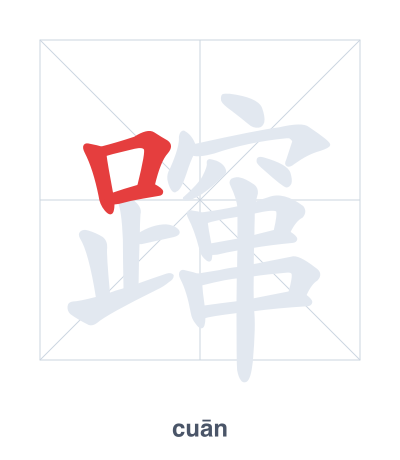
Open Hanzi Writer to see the animated stroke order and practice writing 蹿 with real-time feedback.
The character 蹿 (cuān) is written with 19 strokes. Follow the standard Chinese stroke order: top to bottom, left to right, outside before inside. The radical 足 is one of its key components.
Practice the correct stroke order with the Hanzi Writer app to see animated stroke-by-stroke guidance with real-time feedback.
蹿 means to leap; to jump up.
The character 蹿 combines the foot radical 足 with 窜, which originally showed a rat (鼠) fleeing into a cave (穴). This evokes the quick, darting motion of a rat suddenly springing away, so the whole character means a sudden leap or jump upward.
💡 Memory Tip: Picture a foot (足) kicking a rat (from 窜) that shoots straight up into the air with a startled leap.
这位歌手在网上迅速蹿红。
zhè wèi gē shǒu zài wǎng shàng xùn sù cuān hóng
This singer quickly became famous online.
小猴子在树林里蹿跳。
xiǎo hóu zi zài shù lín lǐ cuān tiào
The little monkey is leaping through the woods.
他的个子一下子蹿高了很多。
tā de gè zi yī xià zi cuān gāo le hěn duō
He suddenly shot up in height.
Open Hanzi Writer to see the animated stroke order and practice writing 蹿 with real-time feedback.
✨ Animated stroke order · Handwriting recognition · HSK-graded practice · Free to use
The character 蹿 is composed of the radical 足 (zú, meaning foot) on the left, and the phonetic component 窜 (cuàn) on the right. Since 足 relates to foot actions, and 窜 means to scurry or flee, together they suggest a quick, leaping movement using the feet.