撺 (cuān) means "to urge; to stir up; to leap" in Chinese. It has 15 strokes with the radical 扌.
Rated 4.2/5 in difficulty (advanced).
Appears in 3+ common words including 撺掇 (cuān duō), 乱撺 (luàn cuān), 撺弄 (cuān nòng).
Due to its 15 strokes, Hanzi Writer's error detection shows 撺 requires focused practice — most learners need 10+ attempts for consistent accuracy.
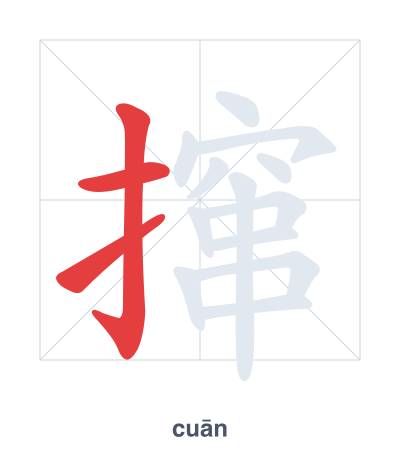
Open Hanzi Writer to see the animated stroke order and practice writing 撺 with real-time feedback.
The character 撺 (cuān) is written with 15 strokes. Follow the standard Chinese stroke order: top to bottom, left to right, outside before inside. The radical 扌 is one of its key components.
Practice the correct stroke order with the Hanzi Writer app to see animated stroke-by-stroke guidance with real-time feedback.
撺 means to urge; to stir up; to leap.
撺 combines the hand radical 扌 with 窜 (cuàn, 'to scurry' or 'flee'). The hand suggests physical action, while 窜 implies quick, darting movement, together conveying the idea of using one's hand to urge someone into swift action or to stir them up, as in prodding someone to leap or flee.
💡 Memory Tip: Picture a hand (扌) giving a strong shove to a mouse that is scurrying away (窜), urging it to leap into action.
他撺掇我去旅游。
tā cuān duō wǒ qù lǚ yóu
He urged me to go traveling.
别在屋里乱撺。
bié zài wū lǐ luàn cuān
Don't run around wildly in the room.
谁在背后撺弄他?
shuí zài bèi hòu cuān nòng tā
Who is egging him on behind his back?
Open Hanzi Writer to see the animated stroke order and practice writing 撺 with real-time feedback.
✨ Animated stroke order · Handwriting recognition · HSK-graded practice · Free to use
撺 uses the radical 扌 (hand) on the left, which shows the action involves the hand. The right part is 窜 (cuàn, to flee; to leap), which gives the sound and adds the idea of quick movement. Together, the character means using your hand to urge someone forward or to leap around.